Root Zone Cooling vs Whole-Greenhouse Air Cooling: 40–70% Less Energy
Why cooling the root zone instead of the whole greenhouse air volume cuts cooling energy by 40–70%, how a root zone cooling system is plumbed, and what to specify for hydroponic, NFT and vertical farms.
In a modern greenhouse or vertical farm, heat is the single most expensive problem to solve. The conventional answer has always been the same: the space is too hot, so cool the space. That means central air conditioning, high-volume fans, or evaporative pad-and-fan systems sized for the entire air volume — thousands, sometimes tens of thousands, of cubic metres.
The capital cost is painful. The operating cost is worse. Whole-space cooling runs continuously through the hottest months, and its electricity bill scales with the volume of air you are conditioning, not with the number of plants you are trying to protect.
A growing number of commercial growers are turning to a different approach — root zone cooling (RZC) — that cools a few hundred litres of water instead of a few thousand cubic metres of air, and produces better crops while doing it.
Why the root zone, not the whole space
Roots cannot transpire — leaves can
Plants regulate their own temperature through transpiration. As long as water and nutrients are available, a leaf can shed excess heat into the air around it. A root cannot. There is no transpiration mechanism below the substrate line, so the root zone has no way to cool itself, and it absorbs whatever temperature its surroundings reach.
Above roughly 25–30 °C in the root zone, three failures follow in sequence:
- Dissolved oxygen collapses. Warm water holds less oxygen. As the nutrient solution climbs past 24 °C, dissolved oxygen falls off sharply and the roots begin to suffocate — even though they are sitting in water.
- Pythium and root rot take hold. Warm, wet, low-oxygen conditions are the ideal environment for Pythium and other waterborne pathogens. Once established in a recirculating system, an outbreak spreads through every channel it touches.
- Nutrient uptake stalls. Damaged root tissue cannot take up calcium, magnesium and trace elements efficiently, so growth stalls even when the nutrient solution is perfectly balanced.
Hold the root zone at 18–22 °C and all three problems recede — even if the air above the canopy is considerably warmer. The canopy tolerates heat far better than the root zone does, which is precisely why cooling the whole air volume to protect the roots is an expensive way to solve the wrong problem.
For the full physiology — dissolved oxygen thresholds by crop, the Pythium risk curve, and root-zone temperature targets for lettuce, tomato, cannabis and leafy greens — see our guide to hydroponic water chillers and root rot prevention.
The energy math: precision beats brute force
The reason root zone cooling saves so much energy is straightforward once you look at what is actually being cooled.
Air has a volumetric heat capacity of roughly 1.2 kJ/m³·K. Water has a volumetric heat capacity of roughly 4,180 kJ/m³·K — about 3,400 times higher. Cooling water is not just more direct; it is thermodynamically far more efficient per unit of heat moved. You are also cooling a far smaller volume.
| Parameter | Whole-space air cooling | Root zone cooling |
|---|---|---|
| What is cooled | Entire greenhouse air volume (thousands of m³) | Nutrient solution and substrate around the roots |
| Cooling load driven by | Air volume × air-change rate × solar gain | Solution volume × ΔT × pull-down hours |
| Relative energy use | 100% (baseline) | 30–60% — a 40–70% saving |
| Path to the root | Indirect: air must first cool the water | Direct: water is the cooling medium |
| Control response | Slow — air has low thermal mass | Fast — water has high thermal mass |
| Effect on humidity | Evaporative systems raise greenhouse RH, favouring fungal disease | Adds no moisture to the air |
The last row matters more than it looks. Pad-and-fan cooling works by evaporating water into the air, which raises relative humidity across the whole house — and high humidity is itself a disease risk. A closed chilled-water loop cools the root zone without putting a single extra gram of water vapour into the canopy.
How a root zone cooling system works
A root zone cooling system is a closed chilled-water loop that moves heat out of the root zone and rejects it outside the growing area. The architecture is the same whether you are running NFT channels, DWC rafts, Dutch buckets or slab substrate:
| Stage | Component | Function |
|---|---|---|
| 1. Generate | Industrial water chiller | Produces chilled water at the target setpoint |
| 2. Distribute | Insulated chilled-water loop | Carries the cooling capacity to the crop |
| 3. Exchange | Root zone heat exchanger, embedded coil, or direct reservoir loop | Absorbs heat from the nutrient solution or substrate |
| 4. Control | Setpoint controller and sensors | Modulates chiller output to hold the root-zone temperature band |
| 5. Return | Return water line | Carries warmed water back to the chiller to be re-cooled |
Two ways to couple the chiller to the crop
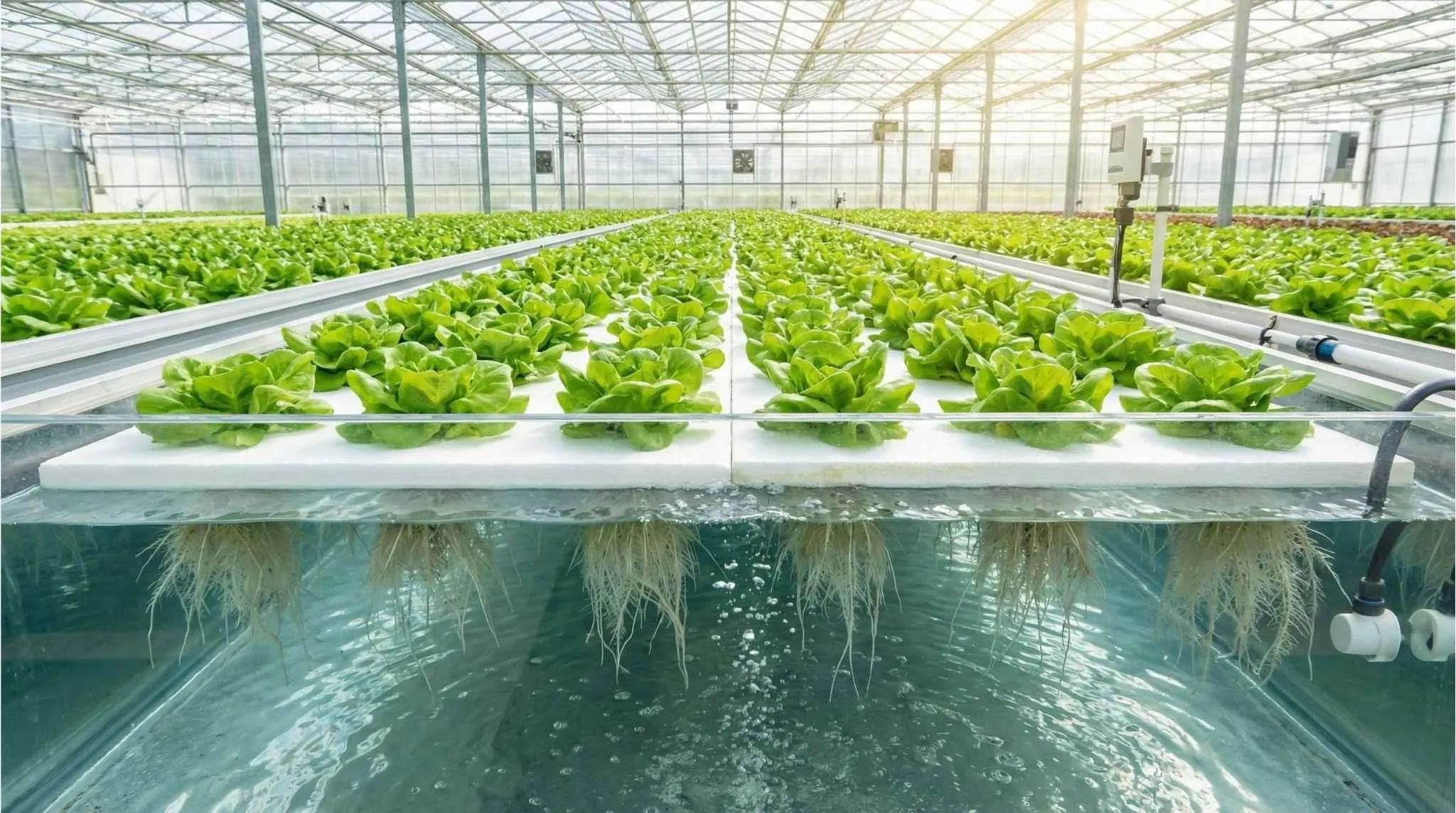
Direct cooling plumbs the chiller straight into the nutrient reservoir. The nutrient solution is the cooling medium. It is the simplest architecture, the cheapest to install, and the most responsive — perfect for DWC rafts, deep-water culture and any system with a central bulk tank. Its one constraint is that every wetted part of the chiller must be compatible with fertiliser salts, which is why titanium or 316 stainless wetted surfaces are non-negotiable in this configuration.
Indirect heat exchange runs a separate closed loop of clean chilled water through titanium or stainless coils buried in the substrate, laid in the growing channel, or cast into the bench. The nutrient solution never enters the chiller, so there is no risk of salt deposition in the evaporator and no risk of metal contamination in the nutrient mix. It is the right choice for slab and substrate crops, for multi-zone houses where one chiller serves several independent irrigation circuits, and for anyone who wants to keep the nutrient recipe completely isolated from the cooling plant.
Whichever you choose, the sizing discipline is identical: calculate the total heat load from the volume you are cooling and the temperature drop you need, not from the circulation flow rate. Our worked example on sizing a chiller for a 1,200-gallon aeroponic reservoir takes the calculation through step by step.
What to look for when specifying root zone cooling
If you are buying a root zone cooling system, you are not buying "a chiller". You are buying a summer yield guarantee and a root rot insurance policy. That changes what you should be checking:
Corrosion-resistant wetted parts. Nutrient solutions are salt brines, and their acidity swings as plants take up ions. A standard copper or mild-steel evaporator will pit and fail within a few seasons. Specify a titanium evaporator or food-grade 316 stainless heat exchanger on every surface the nutrient solution touches. This is the single most common cause of premature chiller failure in horticultural duty.
Dissolved-oxygen co-optimisation. Cooling and aeration are two halves of the same job — the goal is a stable, oxygen-rich root zone, not merely a cold one. Look for a supplier who will size the cooling capacity and the oxygenation strategy together and can explain how they interact at your target setpoint.
Intelligent, crop-aware control. Root zone temperature should track the crop's daily rhythm, not sit on a fixed thermostat. A controller that modulates the setpoint against your light integral and greenhouse temperature and humidity curves — a proper PID loop rather than on/off switching — avoids the cold shock that comes from aggressive pull-down, and avoids the salt precipitation that rapid temperature swings cause in the reservoir.
A system, not a box. The chiller is one component of four: the cooling unit, the root zone heat exchange network, the sensing and control layer, and the system design that ties them to your layout. Suppliers who quote only a box leave you to size the coil, the pump and the loop yourself. Suppliers who quote the system take responsibility for the root zone actually hitting its target.
The bottom line
Root zone cooling is not a compromise between cost and crop quality — it delivers both. By cooling the few hundred litres of water that touch the roots instead of the thousands of cubic metres of air that surround the canopy, a commercial grower cuts cooling energy by 40–70% while holding the root zone in the narrow band where dissolved oxygen stays high, pathogens stay suppressed and nutrient uptake stays constant.
For a business whose output is sold on a forward contract, that stability is worth more than any single season's peak yield. A predictable root zone means a predictable harvest calendar — and a harvest calendar you can commit to is a commercial advantage, not just an agronomic one.
For larger installations — multi-bay greenhouses, combined process and HVAC duty, or sites with several independent cooling circuits — the same engineering scales across our industrial water chiller range, and our titanium evaporators are built in-house for exactly this kind of aggressive water chemistry.
Planning a root zone cooling system? Send us your total solution volume, your hottest ambient temperature, and your target root-zone setpoint. Our thermal engineers will size the chiller, the heat exchange network and the control loop for your layout — contact Delin for a free system design consultation.