Marine Reef & Coral Aquarium Chiller: Stable Seawater Temperature for High-End Tanks
Why high-end saltwater fish tanks and coral reef systems need a seawater-grade chiller — and how Delin's pure-titanium DL-E machine keeps corals, invertebrates and marine fish at a stable temperature, quietly, 24/7.
A high-end marine aquarium is one of the most demanding cooling applications an engineer will be asked to size. A coral reef system is not simply a bigger freshwater fish tank: it is a closed saltwater ecosystem stocked with corals, invertebrates and fish that are expensive individually and unforgiving collectively. The water has to sit inside a narrow temperature band, the equipment has to survive seawater contact for years, and the machine itself often runs next to the room where people live and entertain.
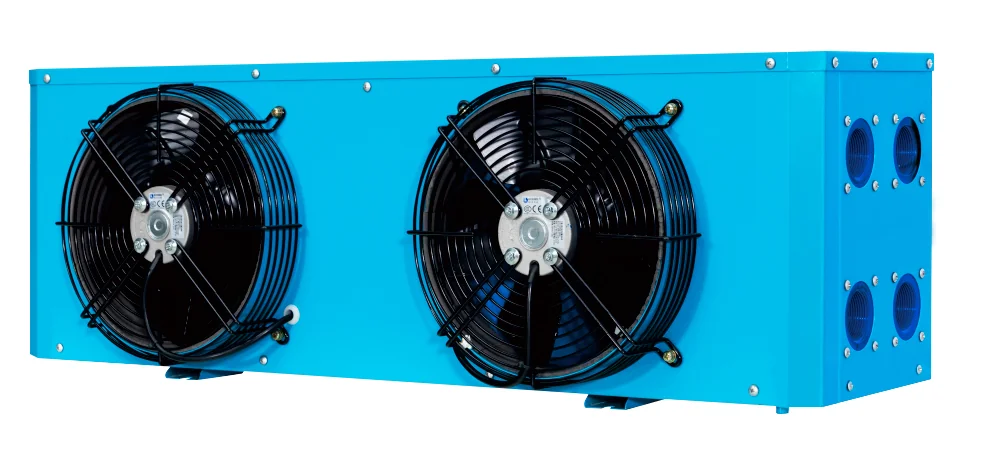
This guide explains what high-end marine and reef tanks demand from a water chiller, why seawater changes the equipment decision, and how Delin builds a constant-temperature machine for exactly that duty.
What a Reef Tank Demands from Its Water Temperature
Corals and reef invertebrates are the least tolerant livestock an aquarium can hold. A typical reef system — SPS and LPS corals, clams, anemones, shrimps and crabs — is kept in a working band of roughly 25–26 °C, and most tropical marine fish do best between 24–28 °C. Even a swing of 1–2 °C stresses corals, slows growth, dulls colour and opens the door to disease; a longer drift can damage or kill colonies that took years to establish.
Heat does not arrive gently in a reef tank. Metal-halide and LED arrays, circulation pumps, wavemakers, skimmers and the ambient room temperature in summer all load heat into the water at once. When that load exceeds what the tank can shed passively, water temperature climbs toward a level that no amount of water-changing will fix — which is why a correctly sized chiller, not a fan or a bag of ice, is the reliable answer.
Why Saltwater Changes the Equipment Decision
Seawater is aggressively corrosive, and that single fact decides which chiller is safe to use. Ordinary heat exchangers built from copper, brass or brazed materials gradually dissolve in saltwater; the released copper ions are lethal to corals, invertebrates and marine fish even at trace levels. This is why the water side of a marine chiller must be pure titanium — a Grade 2 titanium heat exchanger resists seawater corrosion and introduces no metal ions into the display.
Delin uses a pure Grade 2 titanium heat exchanger on the water side of its marine machines — the same corrosion-resistant technology that keeps live seafood tanks and industrial seawater systems running — backed by an anti-corrosion-treated casing for the humid, salt-laden air that surrounds every marine installation.
The Five Concerns High-End Marine Clients Bring Us
When aquarium engineering companies, custom tank builders and serious reef keepers ask Delin to size a chiller, the same five worries come up every time:
- Summer overheating. Pump and lighting heat plus a warm room push the tank past its band exactly when the corals are most stressed.
- Winter temperature swings. Cold drafts and wide indoor temperature swings move the water away from the set-point repeatedly.
- Seawater corrosion of the equipment. A chiller that is not seawater-safe fails quietly — and poisons the tank while it does.
- Noise. A machine that sounds like a plant room has no place beside a display people sit in front of.
- Long-term running stability. A high-end tank runs 24/7, all year. The client is buying years of trouble-free service, not one summer of cooling.
Each of these concerns maps directly onto machine design, which is how Delin engineers its marine constant-temperature machines.
The DL-E Marine Constant-Temperature Machine
Delin's DL-E constant-temperature machines are built on the same platform as our seafood constant-temperature machines, and they answer the five concerns above point by point:
- Pure Grade 2 titanium heat exchanger. Seawater-safe, no copper, no metal-ion release — built for years of saltwater contact, with every titanium coil 100 % hydrostatically tested before shipping.
- Copeland / Emerson / Panasonic compressors. Industrial-grade, head-brand compressors chosen for long 24/7 service under continuous load — the quality backbone a permanent reef system needs.
- ±0.5 °C digital temperature control. A microcomputer controller with auto-diagnosis holds water within half a degree of set-point across a working range of +5 °C to +35 °C — tight enough to hold a 25–26 °C reef band without hunting.
- Low noise (< 55 dB). Engineered to run quietly beside a living-room reef, an office display or a high-end showroom.
- Simple, durable design. Anti-corrosion casing for humid salt air, over-temperature and overload protection, easily reached service points, and a 12-month factory-backed warranty.
Capacities run from 2.8 kW to 85 kW (1–30 HP) with power supply options of 220 V/50 Hz single-phase or 380 V/50 Hz three-phase, and because Delin is the manufacturer the MOQ is just one unit: standard models ship within 15–25 days and custom capacities within 25–40 days.
Who Buys Marine Reef Chillers — and How to Spec One
High-end marine cooling is specified by several kinds of buyer, all of whom buy the same way — on evidence, then on a machine they can trust for years:
- Aquarium engineering companies and custom tank builders installing complete systems — tank, life-support and cooling — as turn-key projects.
- Marine fish and coral vendors keeping valuable display and holding stock in premium condition.
- High-end villa and private collectors whose display is a permanent centrepiece, not a seasonal hobby.
Sizing a reef chiller starts from the heat load, not the tank volume: lighting wattage, pump and equipment load, ambient temperature and the target set-point all count. For a worked heat-load example and a step-by-step selection method, see our ornamental fish aquarium chiller: selection & sizing guide. For large public water features in hotels and shopping malls, our commercial aquarium chiller guide covers the space and noise constraints of those installations.
Send us your tank volume, livestock, lighting load, ambient conditions and target temperature — our engineers will calculate the heat load and recommend the exact DL-E model for your marine or reef system.