Rooftop Water Tank Chiller: High-Ambient T3 Cooling for Saudi Villas & Small Buildings
Why a Saudi rooftop water tank heats past 50 °C in summer, why a standard chiller cannot fix it, and how the DL-T3 high-ambient (T3-rated) process chiller range cools 1,500 L and 3,000 L rooftop tanks to 25 °C in about 9 hours at 50 °C ambient.
In the Saudi summer, a rooftop water tank is not a container — it is a solar collector. A white GRP or steel tank sitting in direct sun, in air that reaches 50–52 °C, heats its stored water far past comfortable drinking temperature. By mid-afternoon the "cold" tap in a Riyadh or Jeddah villa runs warm enough to be uncomfortable — sometimes genuinely hot — and the household is left waiting for the tank to refill and cool overnight. For villas and small commercial buildings that depend on a rooftop tank as their only water reserve, this is a daily problem for four months of the year.
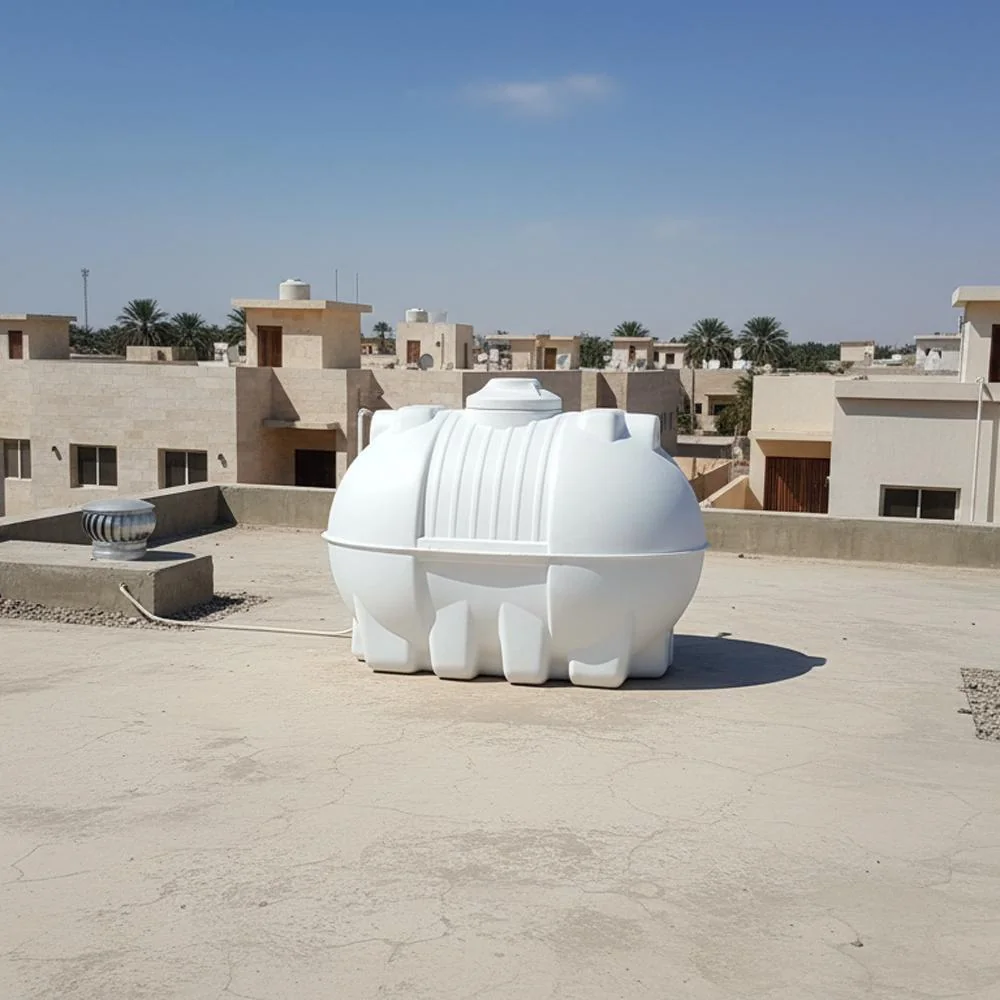
This guide explains why ordinary chillers are not built for that duty, why a high-ambient (T3-rated) process chiller is, and how the Delin DL-T3 range sizes itself to a rooftop tank so the water you store stays usable all summer.
Why a Rooftop Tank Becomes a Solar Collector
- The sun loads the tank all day. A lightly insulated tank absorbs solar gain on its roof and walls, while the 50 °C air slows any natural cooling. Stored water climbs toward — and past — 50 °C.
- The building depends on that water. Most Gulf villas and many small commercial buildings hold their domestic water reserve in a rooftop tank. Hot stored water means a hot "cold" line, poor drinking and showering experience, and unnecessary load on whatever downstream cooling the building has.
- Passive fixes only help at the edges. Shade, white paint and insulation cut the daytime gain, but on a 50 °C design day they cannot hold a tank at a comfortable temperature. The only reliable answer is active cooling.
Why a Standard Chiller Is Not Built for This
A chiller that is perfectly adequate for a factory at 35 °C ambient is the wrong tool on a Saudi rooftop:
- T1 vs T3 climate class. Most standard chillers are designed to a T1 climate class (max 43 °C ambient). A rooftop in Saudi routinely exceeds that. A T3-rated unit is engineered for 55 °C ambient — it keeps working at the temperatures a Gulf roof actually sees.
- Condenser derating. Condenser capacity falls as ambient rises. A unit sized for a mild design day loses net capacity exactly when the tank needs it most — and risks high-pressure trips at 50 °C.
- No water to spare. On a rooftop there is no cooling tower and often no water supply for condenser cooling, so the answer is an air-cooled machine with an oversized, high-ambient condenser package.
The DL-T3 Answer: Two High-Ambient Models, Sized to the Tank
The Delin DL-T3 range is built for exactly this job: air-cooled, T3-rated, with a wetted path safe for potable water. Each model carries a single, checkable performance promise:
| Model | Performance promise at 50 °C ambient | Net cooling at 50 °C | Built for |
|---|---|---|---|
| DL-T3-1500 | Cools 1,500 L from 50 °C to 25 °C in ~9 hours | ≥ 8–10 kW | Saudi villas & small residential buildings |
| DL-T3-3000 | Cools 3,000 L from 50 °C to 25 °C in ~9 hours | ≥ 15–18 kW | Larger villas & small commercial buildings; twin-circuit option available |
Two engineering choices matter for a rooftop tank:
- Air-cooled by design. No condenser water, no drain, no city-water dependency — the unit runs off the same supply as the villa.
- Titanium where water touches. Gulf supply is often desalinated or chlorinated. A pure Grade 2 titanium heat exchanger resists that water and never leaches into it, keeping the wetted loop compatible with drinking water — the same material Delin uses across its seafood and potable-tank installations.
- Redundancy where it counts. On the DL-T3-3000, a twin-circuit / dual-compressor arrangement keeps cooling available even if one circuit is serviced — a summer rooftop is no place for a single point of failure.
Sizing in 30 Seconds
The promise is checkable by hand. Cooling 3,000 L of water by 25 K needs about 87 kWh of heat removed; spread over a 9-hour duty that is roughly 9.7 kW of average cooling. At 50 °C ambient a machine must carry 1.6–2× that average to overcome continuous solar gain and finish on time — which is exactly where the DL-T3-3000's ≥15–18 kW net sits. For the full heat-load walkthrough of the original 3,000 L Gulf tank project — inlet temperatures, derating, the 9-hour figure — see our case study, High-Temperature Pool Chiller: Cooling a 3,000 L Tank in the Gulf Heat.
Rooftop Installation Notes
- Give the condenser clean air. A rooftop already radiates heat; keep the machine clear of parapet walls and hot exhaust paths. Every degree of airflow counts at 50 °C.
- Cool overnight, hold by day. A timer or temperature controller lets the unit pull the tank down at night — when ambient is lower and the chiller runs most efficiently — then maintain setpoint through the afternoon.
- Shade and insulate the tank. Even partial shading and a reflective tank surface cut daytime gain and shorten every cooling cycle.
- Match the circulation circuit. Size the pump to turn the tank over in roughly an hour so temperature stays even, and keep the wetted loop short and serviceable.
Who Specifies a DL-T3 — and How to Start
Rooftop tank cooling in the Gulf is specified by villa owners working with their contractor, by MEP and HVAC contractors, and by owners of small commercial buildings who cannot let stored water go bad. The conversation starts with three numbers: tank volume, worst-case ambient, and target temperature. Send Delin those, and our engineers will confirm which DL-T3 model carries your tank — and quote it factory-direct. We also build to your project specification across the wider industrial process chiller range for larger duty.
Tell us your tank volume, the climate where the roof sits, and the temperature you need — contact Delin and our engineering team will size the high-ambient chiller for your rooftop tank.