Mushroom Growing Room Chiller: Sizing Chilled Water Systems for Commercial Mushroom Farms
Mushroom rooms are latent-load dominated: the coil is a dehumidifier before it is a cooler. How to size a chilled water plant from compost tonnage, why the compressor runs in January, and what to specify for a washdown environment.
A mushroom growing room is not a cold store with the thermostat turned down. It is a machine for holding one organism inside a narrow band of temperature, humidity and carbon dioxide — and the chilled water plant is the part doing the holding. Everything else in the facility, from the compost through to the pickers, sits downstream of whether the room can hold that band on the day the crop decides to fruit.
Fungi do not photosynthesise, so light is not the control variable. Climate is the signal. In commercial practice a drop in temperature and a drop in carbon dioxide are the two events that flip a colonised substrate from vegetative growth to fruiting — which means the cooling plant is not maintaining a condition, it is executing a command. That distinction is what makes mushroom rooms one of the more demanding agricultural cooling applications, and it is why sizing them from a comfort-cooling rule of thumb goes wrong.
This guide covers the cooling plant for button, oyster, shiitake, king oyster and lion's mane production at farm scale: what the room asks of it, how to size it from compost tonnage, and what to write into a specification.
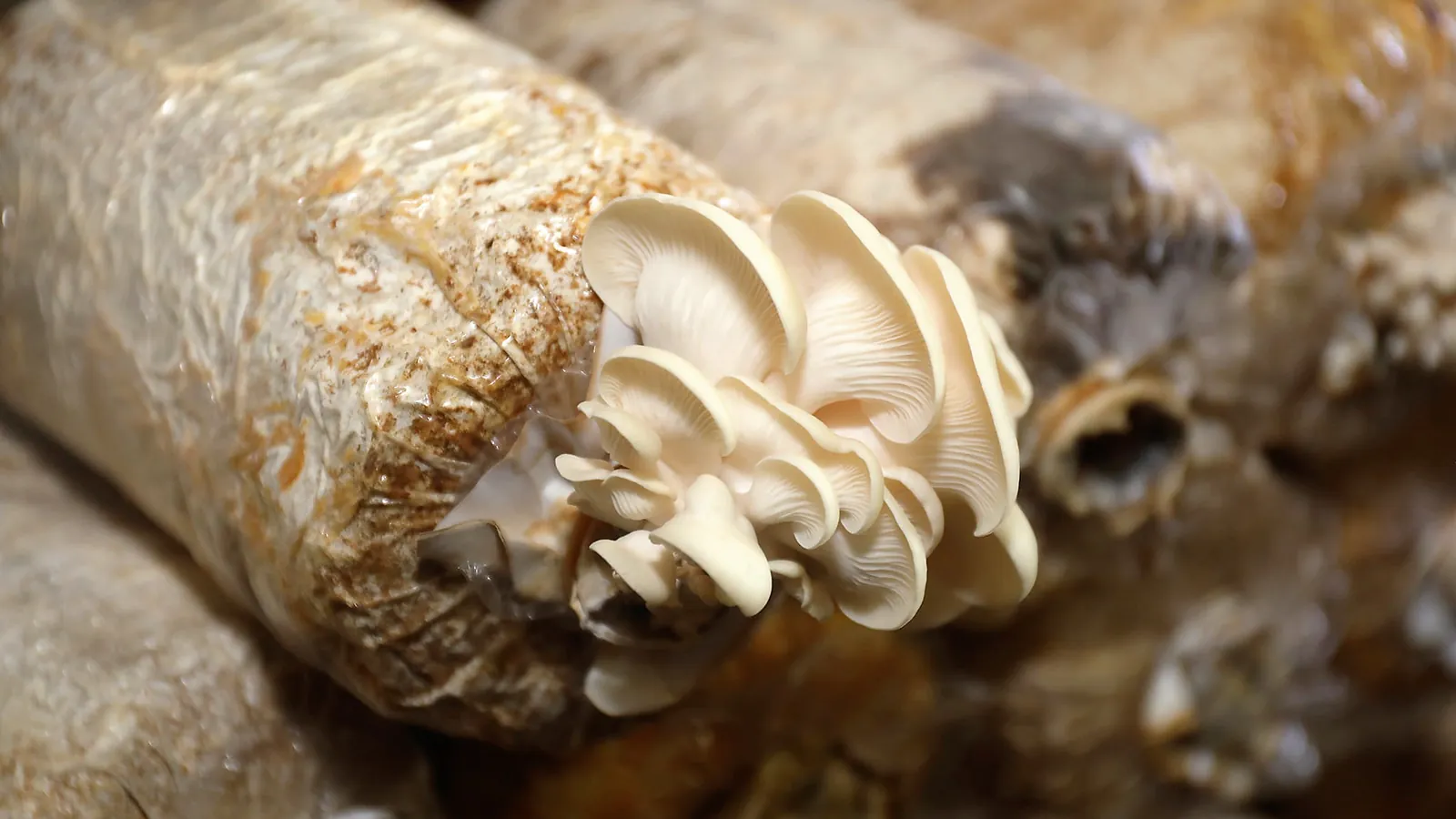
A fruiting room in commercial production. The room's job is to hold temperature, humidity and CO₂ on target while the substrate pushes heat and water into the air around the clock.
The climate the room has to hold
Published ranges vary — sometimes considerably — because strain matters at least as much as species. The table below is the general shape; the figures that come with your culture or spawn should override it.
| Species | Colonisation / spawn run | Pinning and fruiting | CO₂ during fruiting |
|---|---|---|---|
| Button (Agaricus bisporus) | 23–25 °C through casing run | 16–18 °C | below 1,000 ppm |
| Oyster (Pleurotus spp.) | 24–27 °C | strain-dependent: 20–24 °C warm-weather, 10–18 °C cold-weather | 500–700 ppm |
| Shiitake (Lentinula edodes) | 22–27 °C | 12–20 °C, commonly 15–20 °C | 500–1,000 ppm |
| King oyster (Pleurotus eryngii) | 20–25 °C | 12–18 °C | below 1,000 ppm |
| Lion's mane (Hericium erinaceus) | 20–25 °C | 16–20 °C | 500–700 ppm |

Button mushroom (Agaricus bisporus) — the species the cultivation literature, and most of the engineering figures in this guide, are built around.

Oyster mushroom (Pleurotus ostreatus) — the most CO₂-sensitive of the common commercial species, and the most strain-dependent on fruiting temperature.

Shiitake (Lentinula edodes) on a log. Log and block systems load a room very differently, and the plant has to be sized for the one you actually run.

King oyster (Pleurotus eryngii) — the coldest fruiting window of the group, and the least forgiving of a warm room.

Lion's mane (Hericium erinaceus) — sensitive to CO₂ and to direct draughts, which constrains where supply air can be delivered.
Two things in that table drive the engineering.
The fruiting trigger is a step change of roughly 5–10 °C, delivered in a controlled way. A plant that holds ±1 °C at a steady setpoint but takes four hours to pull a room down 8 °C is not the same machine as one that does it in forty minutes — and the difference shows up as uneven pinning, not as an alarm on a display.
The CO₂ requirement inverts between phases. During colonisation, elevated CO₂ of several thousand ppm is normal and fresh air is deliberately minimised. During fruiting, CO₂ has to fall below 1,000 ppm — 500–700 for the more sensitive species — which means a large, deliberate fresh-air exchange. Everything that fresh air carries in with it becomes cooling load.
Most of the load is water, not heat
This is the part of mushroom room cooling that gets misread most often.
A fruiting room is a wet place by design. The substrate is wet, the air is held at 85–95 % relative humidity, and the crop is transpiring continuously. That moisture does not simply stay in the air — it has to be removed and replaced, because the compost itself is a large and ongoing source of it. A chilled water coil in a mushroom room is therefore a dehumidifier first and a cooling coil second.
Published coil data reflects that. Typical practice runs chilled water at roughly 5–6 °C supply — noticeably colder than comfort cooling — precisely so that the coil surface sits below the dew point of the air passing over it and condenses. In one documented button-mushroom project, room-level coils rated around 46 kW each split roughly 14 kW sensible to 32 kW latent: about two-thirds of the duty is water removal, not temperature reduction. The central cooler in the same project runs around 483 kW, roughly 62 % of it latent, stripping more than 400 kg of condensate per hour.
Two practical consequences follow.
The 85–95 % RH figure is not achieved by avoiding dehumidification. It is achieved by dehumidifying at the coil and then re-humidifying downstream, with reheat where the room needs it. The coil and the humidifier are not fighting each other; they are two stages of one system. A specification that asks for a "low-ΔT, high-airflow coil that avoids stripping moisture" for a mushroom room has the physics backwards — the strip is the point.
The coil, the air volume, the reheat and the humidifier have to be sized together. Air quantity is set by the CO₂ target as much as by the cooling requirement. The coil is set by the moisture the room generates. Reheat is set by how far the coil over-cools to condense. A chiller that is correct in isolation will still leave you with a room that will not hold RH if any of the other three are wrong.
Sizing from compost tonnage
The most useful industry rule of thumb sizes the growing room from substrate, not floor area:
Roughly 1.5–2.0 kW of cooling capacity per tonne of compost. A chamber holding 20 tonnes needs a plant in the region of 30–40 kW.
Airflow follows a similar per-tonne basis. On the order of 225 m³ of air per hour per tonne of compost is a commonly cited design figure.
The total is the sum of several sources that do not peak at the same time:
| Load source | Typical figure |
|---|---|
| Building envelope | ~40 W per m² of chamber surface |
| Ventilation fresh-air intake | ~100 W per tonne of compost |
| Metabolic heat, colonised substrate (Phase 3) | ~1,160 W per tonne |
| Metabolic heat, pasteurised compost (Phase 2) | ~1,500–1,600 W per tonne |
| Respiration of fruiting bodies | ~300 W per tonne of substrate |
| Personnel | ~200 W per person |
| Lighting | ~5 W per m² |
The peak is not the fruiting room. It is the sealed colonisation phase, where compost metabolic heat dominates and ventilation is deliberately minimal. A plant designed only around the cropping rooms will be the wrong size for the tunnels.
Across multiple chambers running phase-shifted crop cycles, a diversity factor of roughly 0.5–1.0 applies, because not every room is at peak at the same moment. Choosing that factor badly is one of the two ways a mushroom farm ends up with the wrong plant. The other is sizing on the sensible load alone.
The compressor runs in January
A greenhouse does most of its cooling in summer. A mushroom room does not. The heat in the room comes from the substrate itself — the metabolic activity of a living organism — and that production continues through the winter at essentially the same rate.
The chiller is therefore a year-round machine, and it has to work at both ends of the ambient range. In peak summer the air-cooled condenser is derating and head pressure is climbing. In January the same plant is running at three in the morning with a single-digit ambient and needs to avoid low-pressure trips and evaporator freeze-up. Low-ambient kits, condenser fan speed control and free-cooling economisers exist for exactly this duty, and on a mushroom farm they are not optional extras — they are how the plant survives half the year.
Free cooling is worth costing explicitly for this application: for much of the year, ambient air can carry the load directly and the compressor does not need to run at all.
The room is hostile to the equipment
Eighty-five to ninety-five percent relative humidity, continuous condensation, and a washdown regime that includes peracetic acid, hydrogen peroxide and alkaline cleaners between flushes. Copper and aluminium are the materials that suffer first, and electrical panels do not enjoy saturated air.
In practice: cooling coils inside the room want hydrophobic or epoxy-coated fins and a casing that will not corrode — aluminium-magnesium alloy or stainless rather than painted mild steel. Anything wetted wants stainless or titanium rather than copper. And the refrigeration plant itself belongs outside the growing room, in a mechanical space, where its controls are not sitting in a saturated atmosphere.
That last point is the main structural argument for a hydronic system in this application, and it holds regardless of which manufacturer supplies it: chiller outside, coils inside, chilled water in between.
Chilled water or direct expansion?
Direct expansion is not wrong everywhere. On a single small chamber, a packaged DX grow-room unit is cheaper to buy, simpler to install, and perfectly capable of holding a setpoint. The question is what happens as the operation scales.
| Chilled water plant + AHU coils | Direct expansion units | |
|---|---|---|
| Multi-room control | One plant serves many rooms through motorised valves, each room on its own temperature and humidity profile | A compressor unit per room, or a shared unit that cannot give rooms independent conditions |
| Capacity turndown | VFD or screw compressors modulate continuously as rooms move between phases | On/off cycling, with the temperature and humidity swings that follow |
| Thermal inertia | Water volume buffers the loop, so a compressor step does not become a room event | Every compressor cycle reaches the room directly |
| Equipment environment | Refrigeration plant and electricals sit outside the growing room | Refrigerant lines and controls sit in the saturated air |
| Redundancy | Multiple units or dual circuits on one loop; a failure degrades rather than stops | A failed unit stops its room |
| Free cooling | Economiser can carry the load in cold weather | Not available |
For a farm with three or four rooms that are never out of phase, DX is a legitimate answer and no one should be talked out of it. For a facility running a rolling crop across many chambers, the hydronic loop is the option that scales.
One plant or several
Above roughly 200 kW, the practical answer is usually several units piped in parallel onto a common loop rather than one large machine. The reasons are redundancy — a farm that cannot hold a room's temperature for four hours loses the flush in it — and part-load efficiency, since a rolling crop cycle means the plant rarely sits at its design point.
Modular plant also lets a farm build in stages. Starting with two units and adding a third when the next tunnel is commissioned is a normal pattern, and it is far easier to do on a chilled-water loop than with a wall of self-contained DX units.
What to put in the specification
If you are writing an RFQ for mushroom room cooling, these are the items that determine whether the plant still works in year three:
- Load calculation by phase, not a single figure — Phase 2 and Phase 3 compost cooling, colonisation, and each cropping room separately.
- The latent load stated explicitly, with coil entering and leaving water temperatures and the condensate rate in kg/h.
- The pull-down rate required between colonisation and pinning temperatures, in °C per hour.
- Ambient design range at both ends — summer maximum and winter minimum — and how the plant handles each.
- Airflow per tonne of compost, and the fresh-air volume the CO₂ target implies.
- Materials in contact with wet air and washdown chemicals: fin coating, casing, tube material.
- Control accuracy at the room, remembering that the coil, the reheat and the humidifier each contribute error.
- Redundancy requirement, and what the farm does during a service visit.
Working on a mushroom facility? Contact our engineering team with your compost tonnage, chamber count and crop cycle, and we will build the load calculation and a proposed plant layout around it. Our chilled water units run from 3.5 kW to 210 kW, air- or water-cooled, with the coated heat exchangers and low-ambient options this application needs.
Image credits. Photographs via Wikimedia Commons. Growing room: Primeiro-Ministro (Taur Matan Ruak), public domain. Button mushroom and king oyster: Fumikas Sagisavas, CC0. Oyster mushroom: RomkeHoekstra, CC0. Shiitake: USDA, public domain. Lion's mane: Alex via iNaturalist, CC0. Images cropped, resized and converted to WebP.
Delin HVAC — Chilled water systems for agricultural and industrial cooling. CE / ISO 9001 certified manufacturing.