Cooling the Big-Headed Turtle: Water Chillers for Cold-Water Turtle RAS
Platysternon megacephalum needs 19–23 °C water, and it needs that temperature to move on a seasonal cycle. Where the chiller belongs in an RAS loop, why cold water slows the biofilter, and what to specify for a copper-free chilled-water circuit.
The big-headed turtle (Platysternon megacephalum) does not behave like the turtles most people picture. It does not bask on a log in a warm pond. It walks the bottom of cold, fast, oxygen-rich mountain streams in southern China and mainland Southeast Asia, holding position against the current, and it is the only living member of its family. Its head is too large to retract into its shell — the trait that gives it its name, and the reason keepers describe its temperament as closer to a small snapping turtle than to a pond turtle.
That habitat is the entire engineering brief. A recirculating aquaculture system (RAS) built for this species is not a warm-water system with the thermostat turned down. Cold water changes filtration kinetics, gas solubility and the thermal biology of the animal itself — and the chiller is the component holding all of it steady.
A note on scope. Platysternon megacephalum is listed in CITES Appendix I and assessed as Critically Endangered, so commercial international trade in the animals is prohibited. This guide is written for licensed captive-breeding operations and conservation programmes working under the relevant national permits.
The temperature window is narrow, and 25 °C is the wall
Published husbandry guidance converges tightly, and it is worth stating plainly because the common assumption — that a heat-stressed turtle is in trouble somewhere above 28 °C — is wrong by several degrees:
- Target 19–23 °C. Care sheets give 68–74 °F (20–23 °C); European keeper references work at 19–23 °C.
- 25 °C is the practical ceiling. Guidance warns against prolonged exposure above 25–26 °C, and Chinese-language husbandry sources are blunt that water above 25 °C risks heatstroke and death, with juveniles affected first. If the water could reach 30 °C, the animals have to be moved.
- Below roughly 15 °C the animals become inactive and stop feeding.
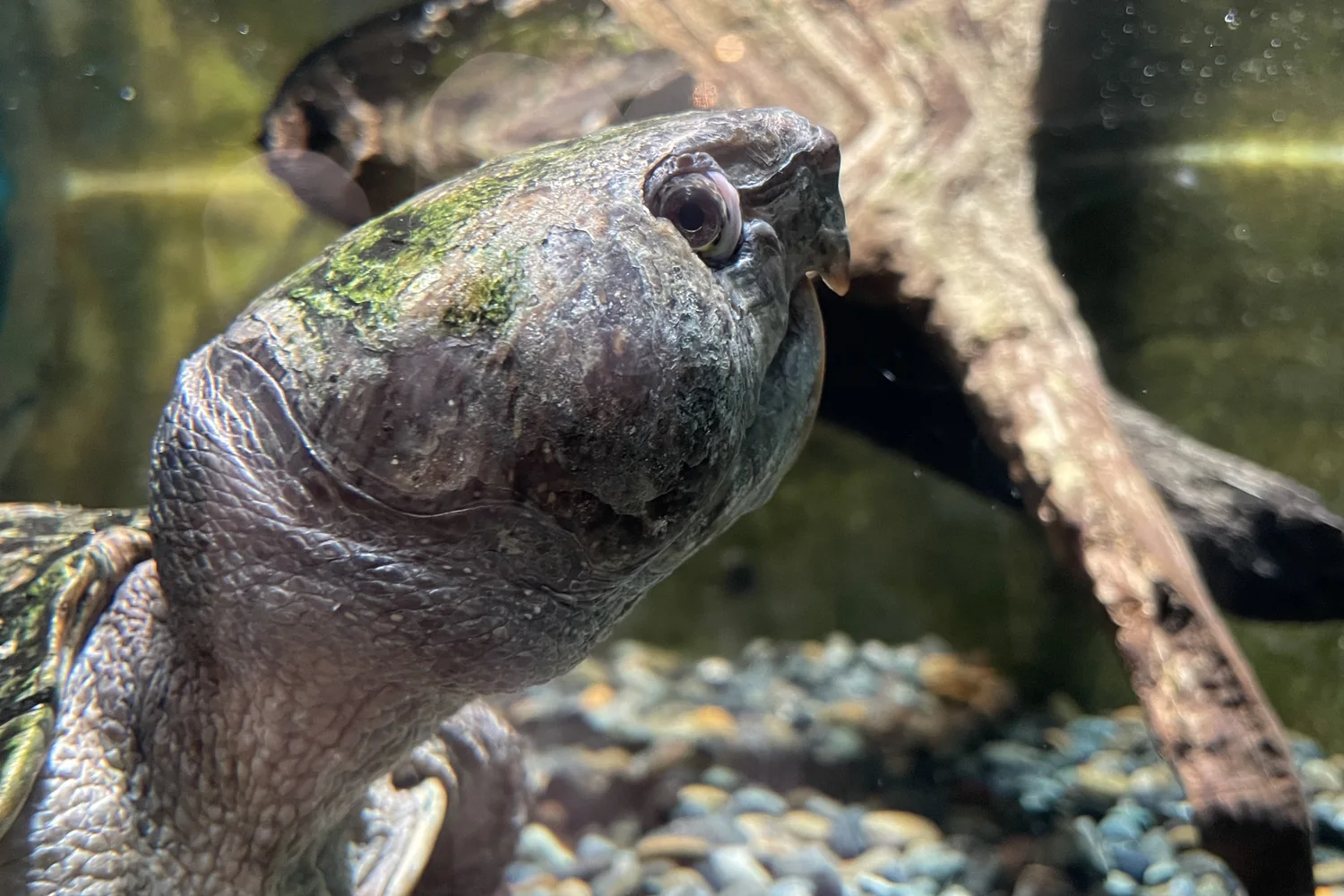
The failure chain is short and it does not reverse. An animal held at 26–28 °C for days goes off feed first, then becomes lethargic, then develops the skin and shell infections that follow immunosuppression in a species that never evolved to sit in warm, still water. By the time the turtle is visibly ill, the water has usually been wrong for a week.
This is why "it is only a few degrees" is the wrong frame. The species' entire tolerance band sits inside a span of roughly six degrees, and the useful working range is narrower still. Equipment that holds ±2 °C is acceptable for a warm-water food fish. It is not acceptable here.
Temperature is not a constant — it is a signal
The most useful thing to understand about cooling this species is that the setpoint should not be fixed.
Captive breeding of Platysternon megacephalum was long considered difficult, and the trade in the species depended on wild-collected animals. Progress came when institutions stopped treating temperature as a constant and started treating it as a seasonal driver. The Wildlife Conservation Society's Prospect Park Zoo reported breeding the species by simulating seasonal change — deliberately fluctuating water and ambient temperatures together with photoperiod — across a multi-year programme. Breeding introductions were made each May, females laid clutches of five to six eggs in July and August, and eggs incubated at 23.3 °C and 90–95 % relative humidity hatched after an average of about 102 days. The same institution then produced hatchlings in successive years, which is the part that matters: a single clutch can be luck, a repeating cycle is a controlled variable.
Read that result as an engineer and the specification becomes obvious. The chiller is not merely keeping animals alive. It is the instrument that delivers the thermal cycle that triggers reproduction. A cooling system that can hold only one setpoint cannot run a breeding programme — you need a plant that can be commanded to hold 20 °C for weeks, then be driven up or down on schedule, repeatably, year after year, with tight control at each plateau.
Two consequences for specification:
- A programmable setpoint with a wide operating range, not a fixed-temperature aquarium chiller.
- Repeatability. A cycle that varies by two degrees between years is not a controlled variable, it is a coin toss. Log the temperature, and if the controller cannot export a history, you cannot tell afterwards whether a failed season was the thermal programme or something else. In a programme working with a Critically Endangered species, that is knowledge you cannot afford to lose.
Where the chiller goes in the loop
The order of a cold-water RAS is not arbitrary:
Culture tank → mechanical filtration → biofiltration → chilling → oxygenation → culture tank
Placing the chiller after both filtration stages is the important part, and it is the mistake most often made in small reptile systems. A chiller fed with unfiltered tank water has its heat exchanger progressively coated in organic film and bio-slime. The result is not a dramatic failure — it is a slow, invisible loss of capacity across a season, arriving exactly when summer load is highest. Filter first, chill second.
Running the chiller as a pumped side loop off a sump, rather than in the main return path, is often the better arrangement. It reduces the head the main pump works against, and it lets the chiller be valved off and serviced without stopping circulation through the biofilter — the one component you least want to disturb.
Cold water slows the biofilter — so size for it
Nitrifying bacteria, the organisms that convert ammonia to nitrate, are optimised for warm water. Their activity peaks in the region of 25–30 °C and falls away as temperature drops. Run a biofilter at 20 °C and it still works — but it processes ammonia meaningfully more slowly than the same filter at 28 °C.
The practical response is to design the biofilter around the cold condition rather than around a warm-water rule of thumb. Facilities working in cold water commonly specify 30–50 % more bio-media volume than a warm-water system carrying the same biomass would need, using high-surface-area media — moving-bed K1/K3, or porous ceramic — so that ammonia conversion stays complete at the low end of the temperature band. Treat that range as a practitioner's starting point and confirm it against your own ammonia and nitrite logs, not as a fixed formula.
This matters more in a breeding system than in a display tank. Broodstock are fed heavily, and heavy feeding means a heavy, variable ammonia load. Combine that with a biofilter running at reduced kinetics and you get the classic cold-water RAS failure: a system that tests clean all winter and crashes in spring.
Oversizing a biofilter is cheap. Recovering a crashed filter in a tank of endangered animals is not.
Oxygenate after the chiller, not before
Cold water holds more dissolved oxygen than warm water — saturation in fresh water is roughly 9.1 mg/L at 20 °C against about 7.6 mg/L at 30 °C. That extra capacity is part of why this species thrives in cold, fast water, and it is a resource the system should actually deliver.
The design point is where the gas exchange sits. Put venturi injectors or fine-bubble diffusers immediately downstream of the chiller, before the water returns to the culture tank:
- Gas dissolves more efficiently into cold water. Transfer improves as temperature falls, so the point in the loop where the water is coldest is the best place in the loop to add gas.
- Gas inside a heat exchanger is a heat-transfer problem. Bubbles carried into a chiller's exchanger promote air-locking and reduce heat transfer. Oxygenating upstream of the chiller works directly against the component you paid for.
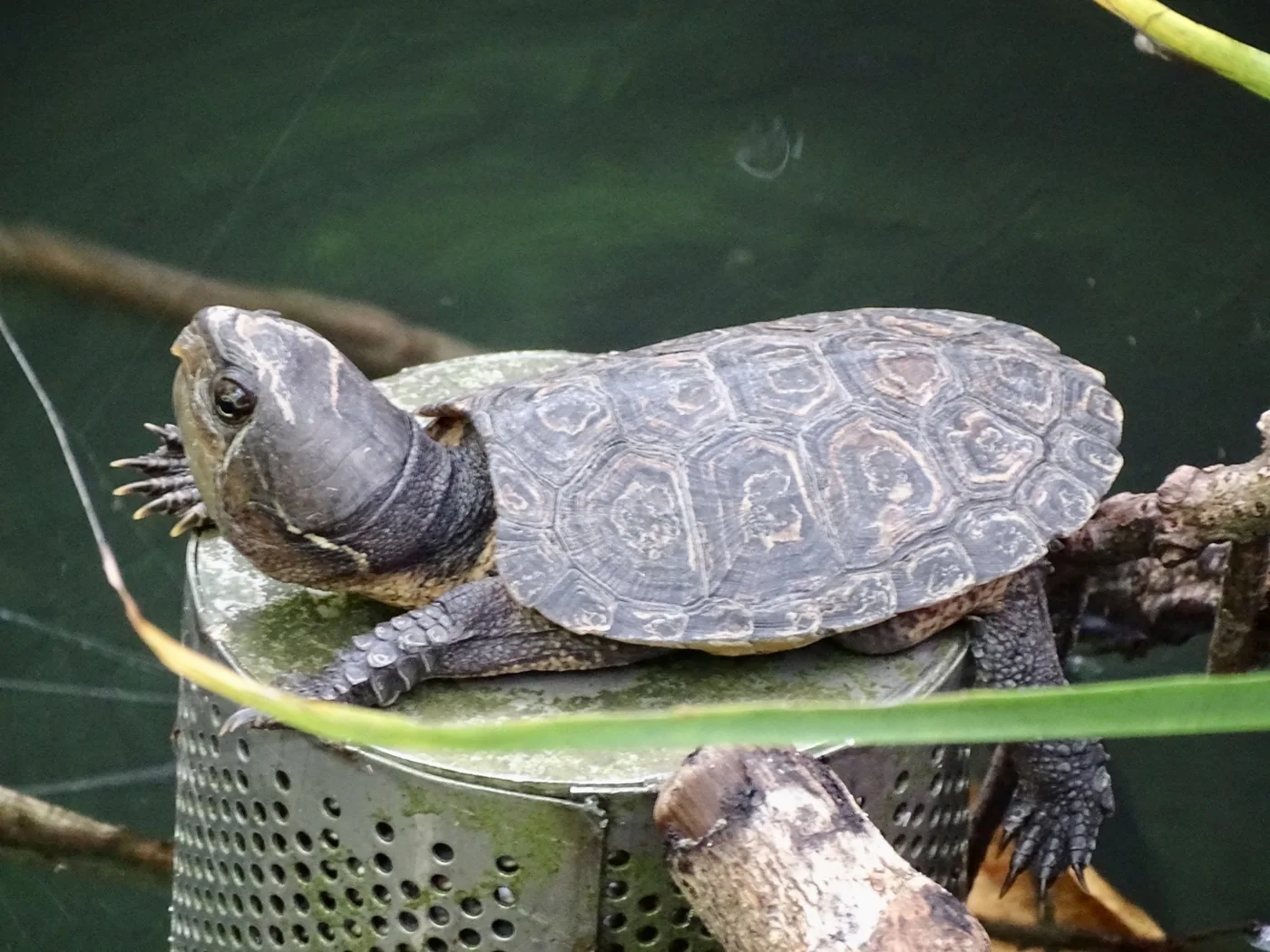
Target dissolved oxygen above 7 mg/L, measured at the tank rather than at the injection point, and hold it through the warmest part of the day, when saturation capacity is at its lowest.
Wetted materials: no copper
Specify titanium or 316 stainless steel for every wetted surface, and titanium for the heat exchanger.
The reason is not only corrosion. Copper is acutely toxic to aquatic organisms, and a copper exchanger in a closed recirculating loop puts the entire system volume in continuous contact with it. The first sign of a leaching problem is generally not a sick turtle — it is a slow decline in the invertebrates and plants in the system, followed by animal health problems that no water test explains, because the kits most facilities use do not screen for copper at the concentrations that matter.
Titanium is standard in aquaculture for exactly this reason: it is inert, it resists the slightly acidic, soft water this species comes from, and it puts nothing into the water. Specify it once and the question is closed for the life of the machine.
Noise, vibration and installation
Big-headed turtles are nervous animals, and they are also exceptional climbers with a well-documented tendency to escape; they are not a species that settles easily into a busy room. That is an argument from husbandry for keeping the culture area quiet and low-traffic. It is not a claim about measured stress physiology — that is not well quantified for this species in the literature, and anyone quoting a figure for it is quoting something else.
There is a purely mechanical argument for the same conclusion. Compressor vibration transmitted into pipework and structure is one of the commoner causes of premature failure in small chilled-water installations: it works fittings loose, fatigues joints, and eventually produces a leak in the part of the loop that is hardest to reach. The remedy is standard good practice — anti-vibration mounts under the chiller, flexible couplings on the inlet and outlet, and the machine sited outside the culture room wherever possible with chilled water piped in.
If the chiller must share a room with the tanks, remember that a machine rated for noise in a warehouse is not rated for noise beside a breeding tank. Low-noise construction — insulated cabinetry, high-efficiency quiet compressors — is worth specifying for the same reason you would specify it in a laboratory.
The same engineering applies to other cold-water species
Nothing in this guide is specific to Platysternon. Anyone running a cold-water RAS for Cuora, Mauremys, Sacalia, Clemmys, Glyptemys or Emys faces the same three problems: a narrow thermal band, nitrification that slows with temperature, and a chiller that has to sit downstream of filtration. The setpoint and the seasonal programme change with the species. The plant design does not.
Running a breeding programme, or building one? Send us your species, your system volume, your target temperature band and — if you are cycling temperature seasonally — the programme you are trying to hold. Our thermal engineers will size the chiller, the loop and the heat exchanger for a cold-water RAS, and tell you honestly whether your existing plant can hold the cycle you need. Contact Delin for a free system design consultation.
Header image: "Platysternon megacephalum Gifu" by Totti, Wikimedia Commons, CC BY-SA 4.0. Head detail: "Platysternon megacephalum Head" by Totti, Wikimedia Commons, CC BY-SA 4.0. Aeration photograph by Toby Y via iNaturalist, CC BY 4.0. Images resized for web; no other modification. Article text © Delin.