Aquarium Chiller Plumbing and Flow Matching: Hydraulic Design for Large Tanks
The chiller is the easy part — the plumbing is what decides whether it works. Why a titanium barrel rated at 3 m³/h cannot be fed by a 12 m³/h display loop, how to size pipe by velocity, and the commissioning checks that catch the mistake before the fish do.
A four-tonne tank changes the nature of the job. At 4,000 litres the water has enough thermal mass that a chiller rarely has to fight a fast temperature swing — and enough that nothing about the installation can be improvised. The cooling capacity is usually the straightforward part. What decides whether the system actually holds 20 °C is the hydraulics: how much water the chiller's heat exchanger is rated to see, how much the display loop wants to move, and what sits between the two.
This guide is about that gap. It uses a 4,000 litre cold-water stream biotope — the kind of tank built for East Asian stream cyprinids — as the worked example, because that application makes the mismatch between the two flow rates impossible to ignore.
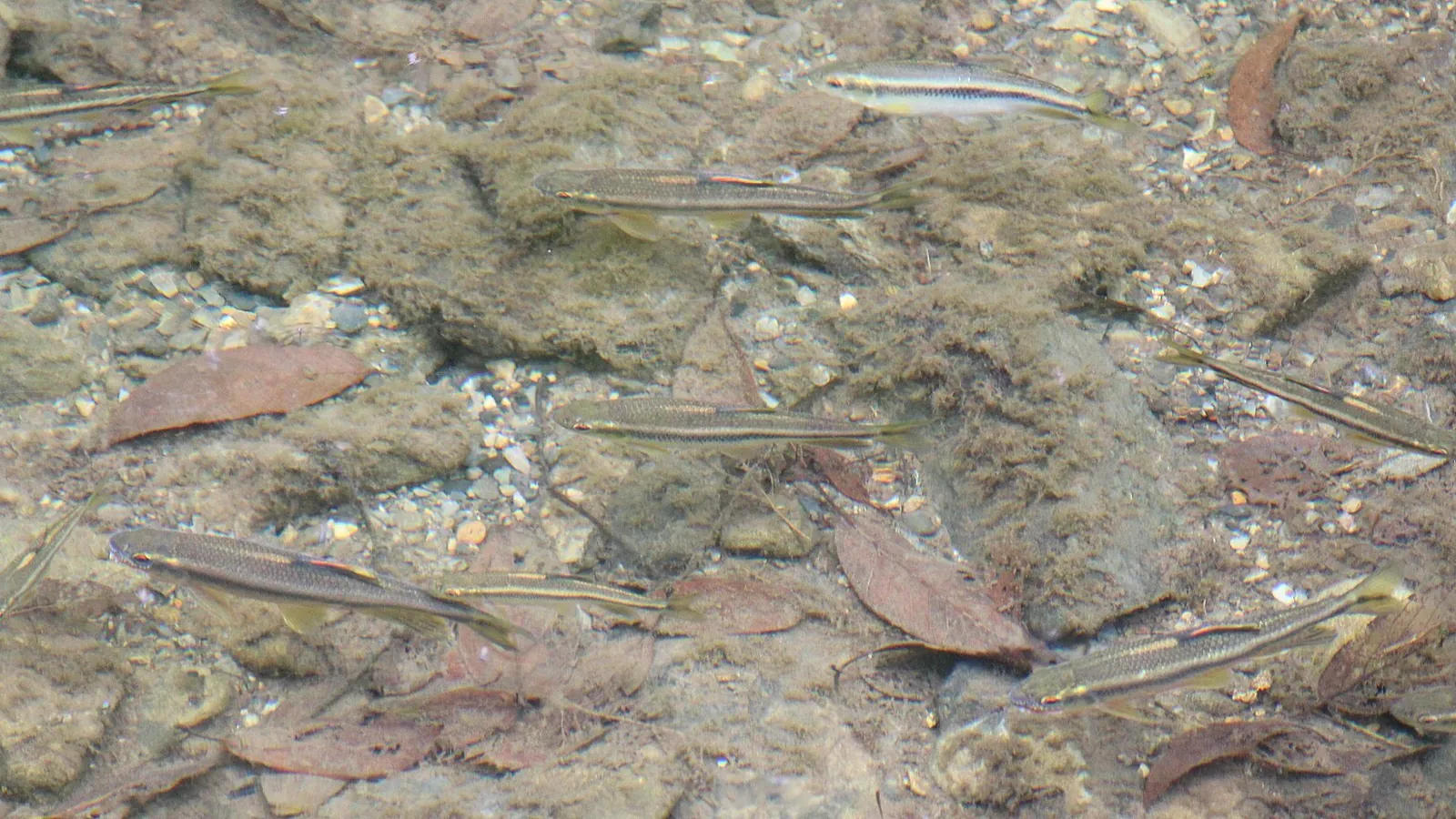
A Japanese hill stream: clear, cold, highly oxygenated, and moving. Every design decision in a tank like this is an attempt to reproduce these four properties at 4,000 litres.
What the tank has to hold
The species usually grouped under the Chinese hobby term 鱲 — the stream-dwelling cyprinids — are not one genus. Most of what used to sit in Zacco has been redistributed into Nipponocypris, Candidia, Parazacco and Opsariichthys, so a mixed "native stream" tank is usually a mixed-genus tank that happens to share a habitat.
| Species | Common name | Native range | Why it matters in the tank |
|---|---|---|---|
| Opsariichthys bidens | Chinese hooksnout carp | Fast-flowing waters of East and Southeast Asia | The committed piscivore, and the largest fish here — up to about 22 cm. Males are markedly larger than females. It sets the minimum footprint and the tankmate rules. |
| Zacco platypus | Pale chub | Japan, Korea, China | The type species of Zacco, and the one whose males carry the blue-and-pink nuptial colouring that motivates most of these builds. |
| Nipponocypris temminckii | Dark chub | China, Japan, Korea | Grows to about 15 cm and shows a hard dark lateral stripe. The most tolerant of cool water of the three. |
| Parazacco spilurus | Predaceous chub | Southern China | Smaller and less often kept; included here because it appears in mixed 鱲 shipments and behaves like the rest. |
The water parameters that circulate for this group are consistent enough to design against, though your stock's source water is always the better guide:
| Parameter | Target | Note |
|---|---|---|
| Temperature | 18–22 °C | These are temperate stream fish. Sustained temperatures above roughly 26 °C degrade condition, suppress colour and, at the top of the range, kill. |
| Dissolved oxygen | 7 mg/L or above | The binding constraint, and the one that couples directly to the cooling plant: warm water holds less oxygen, so a cooling failure becomes an oxygen failure. |
| pH | 6.8–7.5 | Neutral to slightly alkaline; these fish are not fussy about hardness. |
| Flow | High, with a refuge | Fish should be able to choose between standing in the current and resting out of it. |
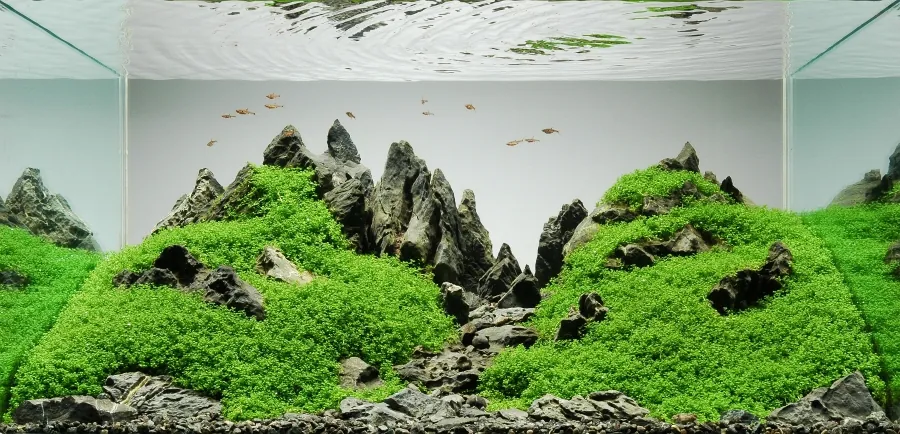
A nature-style aquascape using the same structural vocabulary as the wild habitat: rock, gradient, and open water for the fish to hold station in. The aquascape is the visible half of the build; the plant room is the half that keeps the fish alive.
Sizing, briefly
Working out the required cooling capacity is a load calculation, not a volume lookup, and it has been covered in detail in our guide to sizing an ornamental fish chiller. Rather than repeat it, here is the shape of it for a 4,000 litre cold-water tank:
| Load source | Typical figure |
|---|---|
| Heat gain through glass (12 K lift, ~9–16 m² exposed surface) | 0.6–1.0 kW |
| Return pump and wavemakers | 0.15 kW |
| Lighting | 0.15 kW |
| Continuous load to remove | ≈ 1.0–1.5 kW |
That total is the number the plant has to hold, and it is worth sitting with, because it is much smaller than most people expect. Holding a 4,000 litre tank at 20 °C in a 32 °C room is roughly a 1 kW duty. A 1 HP machine could hold it.
What a 1 HP machine cannot do is get there quickly. Pulling 4,000 litres down by 5 K removes 4,000 × 4.18 × 5 = 83,600 kJ, or about 23 kWh. At a nominal 7.5 kW with a 32 °C ambient derating and the ongoing load deducted, you have something closer to 5–6 kW net, so a 3 HP unit needs roughly four hours for that pull-down. A 5 HP unit does it in about two. That pull-down rate — and summer reserve — is the honest reason a 4-tonne tank usually ends up on 3–5 HP rather than 1 HP, and it is a better argument than capacity alone. Beyond 5 HP for this volume you are buying short-cycling, not performance.
The tank loop and the chiller loop are not the same loop
This is the part that goes wrong, and it goes wrong because both numbers are quoted in the same units without anyone comparing them.
A large cold-water display wants a high turnover. Two to three full tank volumes per hour is a reasonable target for stream fish that live in moving water, which for 4,000 litres means 8,000–12,000 L/h through the display loop.
The titanium barrel on the chiller does not want that. A titanium barrel evaporator is typically rated at around 1 m³/h per HP of chiller capacity. Do the arithmetic on what that implies and you get a design basis you can check against any unit's datasheet:
| Chiller | Barrel rated flow | Resulting ΔT across the barrel |
|---|---|---|
| 3 HP (≈7.5 kW) | ≈3,000 L/h | ≈2 K |
| 5 HP (≈12.5 kW) | ≈5,000 L/h | ≈2 K |
A 2 K drop across the barrel is the design point. It is why the flow is what it is, and it is the number to hold on to.
So the display loop moves 8,000–12,000 L/h and the barrel wants 3,000–5,000 L/h. You cannot put a 12 m³/h loop straight through a 3 m³/h barrel, and on a large tank the temptation to try is strong, because the pump is already there and Teeing it off looks like extra work.
What happens if you do:
- Pressure drop climbs sharply. Barrel evaporators are not designed for that velocity, and the pump's duty point moves down its curve. You get less flow than the pump's rating at higher head, so the extra capacity is partly imaginary.
- Temperature control gets worse, not better. More flow means a smaller ΔT across the barrel. Some controllers regulate on the leaving-water temperature and behave badly when the split is tiny. You have spent pump energy to make the signal noisier.
- Erosion and noise. Sustained high velocity in a small-diameter barrel is hard on tube ends and loud.
And the opposite error, under-flowing the barrel, is worse:
- Local over-cooling. Too little flow means the refrigerant side pulls the water in the barrel well below setpoint. Ice forms on the tubes, the freeze stat trips, and in the worst case you get liquid refrigerant returning to the compressor.
Both failure modes are avoidable with the same piece of equipment.
Size pipe by velocity, not by what fits
Pipe is not selected by matching it to the pump outlet. It is selected by keeping velocity inside a range where pressure drop stays sane and the pipe stays quiet. Two working limits cover most aquarium plant:
- ≤ 1.5 m/s on the discharge side
- ≤ 1.0 m/s on the suction side
Apply them to the two circuits and the sizes fall out:
| Circuit | Flow | Velocity at 1¼″ | Velocity at 1½″ | Velocity at 2″ |
|---|---|---|---|---|
| Chiller branch (3 HP) | 3,000 L/h | ≈1.3 m/s | ≈0.6 m/s | — |
| Chiller branch (5 HP) | 5,000 L/h | ≈1.3 m/s | ≈1.0 m/s | — |
| Display loop | 10,000 L/h | — | ≈1.9 m/s | ≈1.2 m/s |
Read it the other way round and the answer is: 1¼–1½″ for the chiller branch, 2″ for the display loop. Note how much smaller the chiller branch is than the main run — that difference is the whole point of the next section.
Use rigid pressure pipe — solvent-weld UPVC or PVC — rather than flexible hose. Hose sags, kinks at bends, collapses on the suction side under restriction, and its internal surface roughens. On a permanent installation at these flow rates it is a false economy. Where you do need flexibility, at the chiller connections, use a proper reinforced flexible connector, not a length of clear tubing.
The bypass is the design
The bridge between an 8,000–12,000 L/h display loop and a 3,000–5,000 L/h barrel is a bypass: the barrel sits on a branch tee'd off the main return, and valves let you set how much of the flow goes through it.
Three valves, arranged so the branch can be isolated without draining anything:
- A throttling valve on the branch, downstream of the branch tee. This is the one that sets the flow through the barrel, and it is the valve you will adjust during commissioning.
- An isolation valve on the branch, upstream of the chiller. Closes the branch for service.
- A balancing valve or gate on the main run between the two tees. As you open the branch, more water diverts; this valve keeps the main return from starving.
The reason to build it this way rather than with a dedicated pump is maintenance. With a bypass and isolation valves, the chiller can be drained, flushed, descaled and put back while the tank keeps circulating. With a dedicated pump and no bypass, servicing the chiller means stopping the biological filtration on a 4,000 litre system — which, on a tank carrying this much fish, is not a small thing.
If you do prefer a dedicated pump for the chiller branch, size it for the barrel's rated flow at the actual duty point, not for the pump's free-flow rating. Allow for the pressure drop through the pipe run, the fittings, the strainer and the barrel itself; on a typical installation that consumes a substantial fraction of the pump's nominal head, and a pump chosen on its catalogue free-flow number will under-deliver exactly where you need it.
Protection, condensation and vibration
Three details that are cheap at build time and expensive afterwards.
Strainer before the barrel. A basket strainer on the branch, upstream of the chiller, is the single most valuable fitting in the system. Titanium tubes do not corrode, but they do block. A barrel plugged with plant fragments or a dead snail is a barrel with almost no flow — which is the under-flow failure mode above, arrived at by accident.
Insulation on everything cold. At 20 °C water in a 32 °C room at 70 % relative humidity, the dew point is around 26 °C. Every pipe, valve, strainer body and fitting that carries water below that temperature will condense, continuously, all summer. Insulate the chilled side of the branch — closed-cell elastomeric, vapour-sealed at the joints — and insulate the barrel if it sits in the open. Uninsulated cold pipe on a large tank does not just drip; it makes the room damp and it makes the chiller run harder than the load requires.
Vibration isolation and flexible connections at the chiller. A chiller has a compressor in it. Hard-piping a vibrating machine into a rigid run of solvent-weld pipe fatigues the joints at the connections, and on a barrel evaporator those joints are the ones you least want to re-make later. Use flexible connectors rated for the duty on both the inlet and the outlet, and give the unit its own isolation feet.
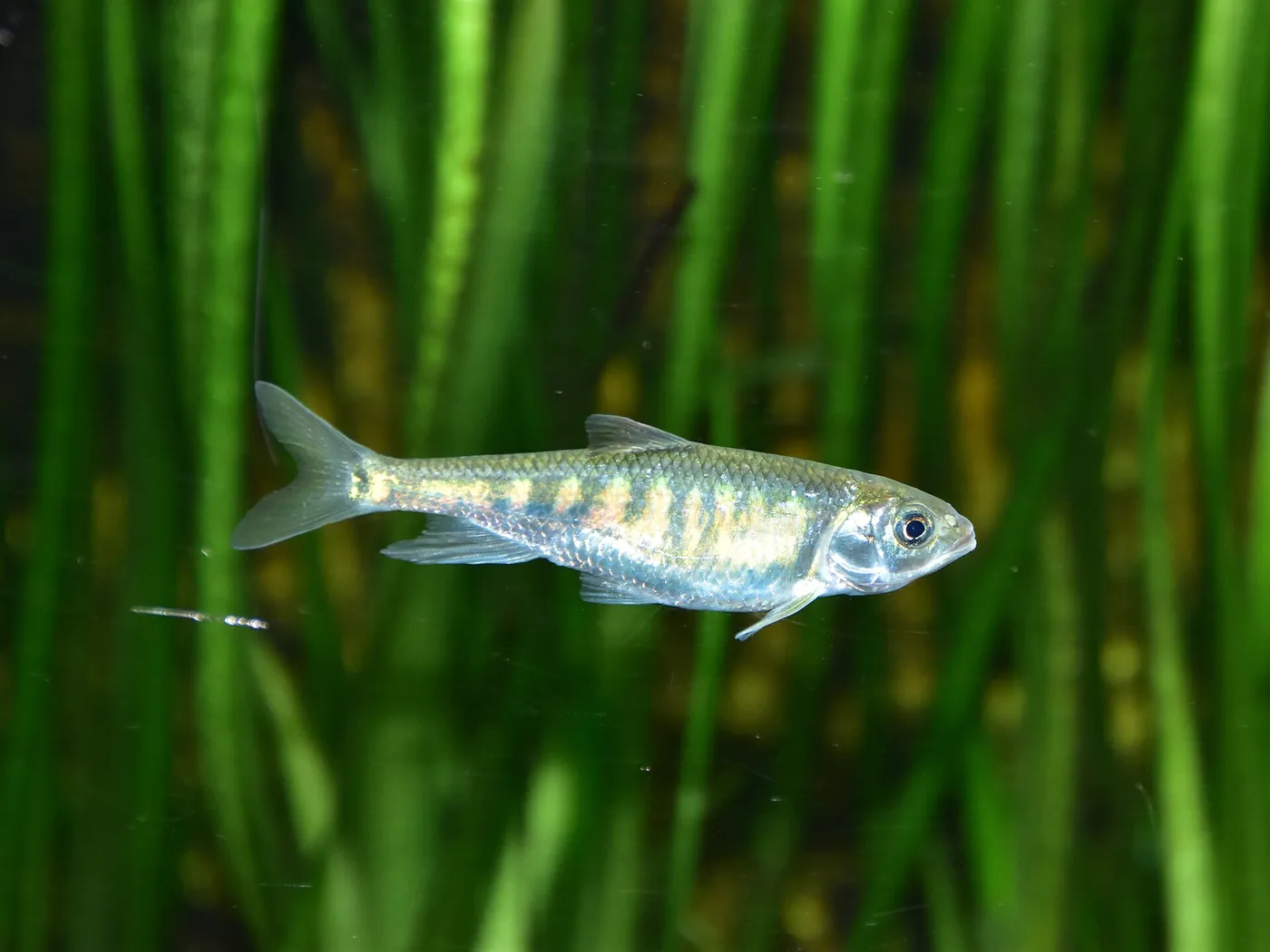
Pale chub (Zacco platypus). The species most keepers build these tanks for, and the one whose colour is most obviously lost when the temperature drifts high.
A chiller only cools
One consequence of this application that is easy to miss until the first winter: a chiller has no way to add heat.
If the tank sits in a room that drops to 12 °C in January, the water will follow it down and the chiller will simply switch off and stay off. For these fish that is not a crisis — they are temperate species and cold water is the direction they tolerate — but it does mean a plant sized and specified only as a cooling machine cannot deliver a stable 20 °C year-round in an unheated space. If stable temperature is the objective, the specification needs a heating element or a reversible unit as well, and the control scheme needs to hand over between them cleanly rather than letting them fight.
State the room's winter minimum in the enquiry. It changes what you are buying.
One more practical note before the equipment list: four tonnes of water is a structural load, and it is a live load. Confirm what is underneath the floor before the tank goes in, not after.
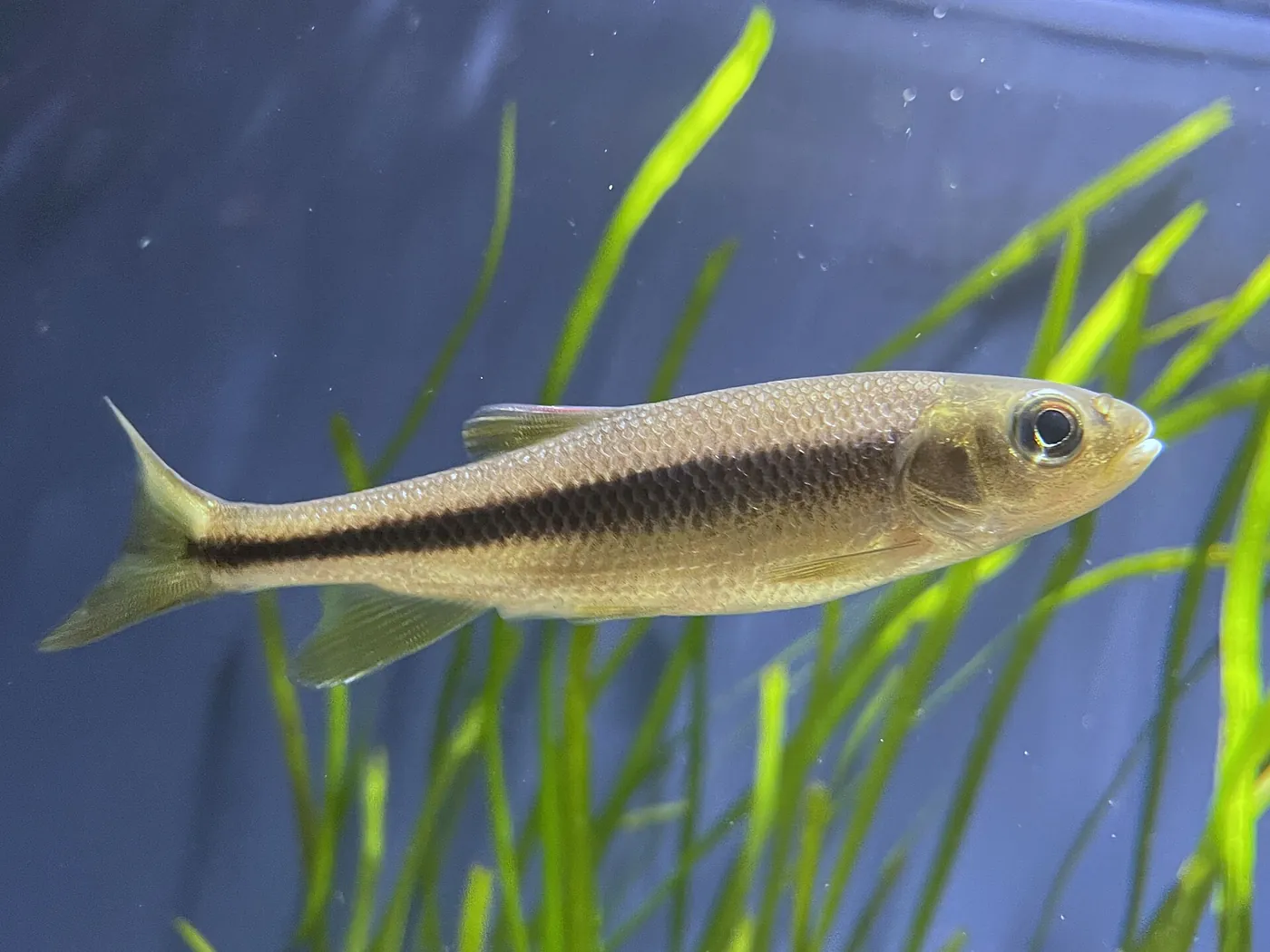
Dark chub (Nipponocypris temminckii), showing the dark lateral stripe that separates it at a glance from the pale chub above. Formerly placed in Zacco; the genus was split, which is why the hobby names and the scientific names no longer line up one-to-one.
Commissioning: water before power
The sequence matters, and the most common way to damage a new installation is to skip the first step.
- Water first, power second. With the chiller switched off, run the circulating pump for 15–30 minutes. Check every solvent-weld joint, union and threaded connection for weeping. Purge air from the barrel — an air pocket in the evaporator is both a heat-transfer loss and a freeze risk.
- Verify flow before you trust it. Once the chiller is running, confirm there is no flow-error alarm and listen to the barrel. Steady flow sounds steady. Cavitation sounds like gravel, and it means the suction side is restricted or the pump is being starved.
- Set the branch flow. Adjust the throttling valve on the bypass until the barrel sees its rated flow. This is where the numbers in the flow table above get used.
- Calibrate the temperature offset. Run the system for two hours, then compare the chiller's displayed temperature with an independent thermometer in the main body of the tank. Where the sensor sits at the chiller and the bulk of the water are separated by a long pipe run and a pump, they will disagree. Apply the offset on the controller so the machine regulates the tank, not the plant room.
- Watch the first hot day. A new installation should be observed through a summer peak, not commissioned in spring and forgotten. The ambient derating on an air-cooled condenser is real, and a plant with no margin shows it in July, not in April.
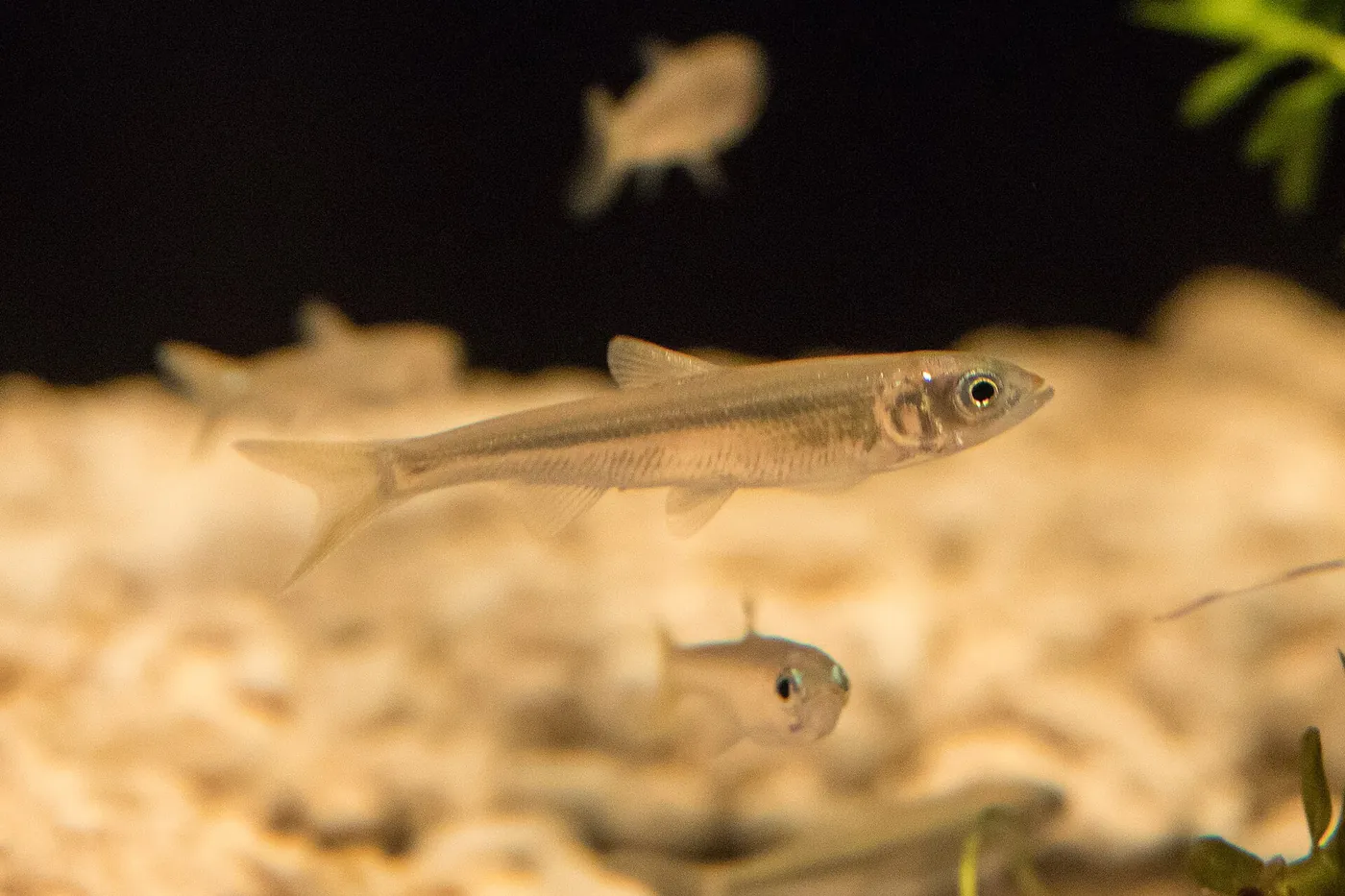
Three-lips (Opsariichthys uncirostris), the Japanese congener of the Chinese hooksnout carp that heads the species table above. No free-licensed photograph of Opsariichthys bidens itself was available for this article; this is the same genus, the same piscivorous habit and the same body plan, and it is offered as such rather than as a substitute.
What to put in the specification
If you are writing an enquiry for the cooling plant on a large cold-water tank, these are the items that determine whether the installation works:
- Water volume, target temperature and the room's summer maximum, so the load can be calculated rather than estimated.
- The room's winter minimum, so the heating side of the question is answered at the same time.
- Required pull-down rate — how fast the tank has to come down from ambient after a water change, in K per hour.
- Display loop turnover in L/h, stated separately from the chiller branch flow.
- The barrel's rated flow and the ΔT it corresponds to, so the bypass can be designed around a real number.
- Pipe sizes and material for both circuits, with the velocity limits you are designing to.
- Insulation scope on the chilled side, and the ambient humidity it has to survive.
- Strainer, isolation and bypass arrangement, so the plant can be serviced with the tank running.
- Materials in contact with water: titanium for the exchanger, and no copper anywhere downstream of the pump.
- Control accuracy and where the sensor sits — at the chiller, or in the tank.
Working on a large tank or a holding system? Contact our engineering team with the volume, the target temperature and the room's ambient range, and we will work the load calculation and a hydraulic layout around it. Our DL-E constant-temperature machines run from 1 HP to 30 HP with pure titanium heat exchangers and ±0.5 °C control.
Image credits. Photographs via Wikimedia Commons. Dark chub in river: Alpsdake, CC BY-SA 3.0. Mountain-scape aquascape: Peter Kirwan, CC BY-SA 3.0. Pale chub: NasserHalaweh, CC BY-SA 4.0. Dark chub portrait: Totti, CC BY-SA 4.0. Three-lips: Σ64, CC BY 4.0. Images cropped, resized and converted to WebP.
Delin HVAC — Chilled water systems for agricultural and industrial cooling. CE / ISO 9001 certified manufacturing.