Air-Cooled vs. Water-Cooled Chiller: Pros, Cons & Sizing for Large Marine Aquariums
Standard commercial air-cooled chiller or purpose-built water-cooled chiller — which one protects a large marine aquarium? A plain-language comparison of cost, corrosion, footprint and the parallel sizing a 135-tonne tank actually needs.
A large marine aquarium — a public oceanarium, a hotel centrepiece, or a commercial holding system — does not cool the same way a small reef tank does. When water volume reaches tens or hundreds of tonnes, the chiller has to fight ambient heat, high-powered circulation pumps and banks of display lighting, while staying safe for the livestock swimming in it. That last requirement is the one that decides the whole equipment question: a generic air-cooled chiller and a purpose-built water-cooled chiller are not interchangeable once delicate marine life is involved.
This article compares the two approaches side by side — a standard commercial air-cooled chiller versus a marine-grade water-cooled chiller — and shows how to size either one for an extra-large tank.
Two Ways to Cool a Large Marine Aquarium
Both machines here are water chillers: they pull heat out of the tank water. What separates them is the material that touches your tank water, and how the whole unit is built to live in a salt-laden marine plant room.
- A standard commercial air-cooled chiller is an off-the-shelf industrial machine. Its condenser sheds heat through aluminium fin-tube coils, and its water side is ordinary alloy — or has been retrofitted to survive saltwater.
- A water-cooled chiller is purpose-built for seawater. Every surface that touches the water is commercially pure titanium, and the cabinet, fins and controls are engineered to withstand a humid, salt-spray environment year after year.
That difference in construction is the whole story. Let us look at each in turn.
Option 1: Standard Commercial Air-Cooled Chiller
The standard air-cooled chiller is the familiar industrial workhorse: a compressor, an aluminium fin-tube condenser cooled by ambient air, and an evaporator that chills the tank water. For a marine application, the buyer typically specifies an anti-corrosive heat exchanger — for example a PVC-titanium retrofit — to keep the saltwater from attacking the water side.
The advantages
- Lower capital cost. Standardised industrial designs bring the upfront equipment price down, which matters on budget-sensitive projects.
- Simple standalone installation. An integrated air-cooled unit needs no external cooling tower and no secondary water circuit, so it drops in cleanly wherever there is well-ventilated space.
The disadvantages
- It is hostage to the weather. Above about 35 °C ambient, efficiency falls sharply: the hotter the air, the harder the unit works to reject the same heat. Coefficient of Performance (COP) drops, and high-pressure safety trips become a real risk exactly when the tank most needs cooling.
- Noise and ventilation. Large axial fans on top of the unit push a lot of air and generate low-frequency vibration, which rules out quiet indoor display areas.
- Fin fouling and corrosion. Exposed condenser fins collect dust, leaves and — critically — coastal salt spray. Even with a basic protective coating, long-term exposure to marine fog or saline moisture degrades the fins and can eventually lead to refrigerant leakage.
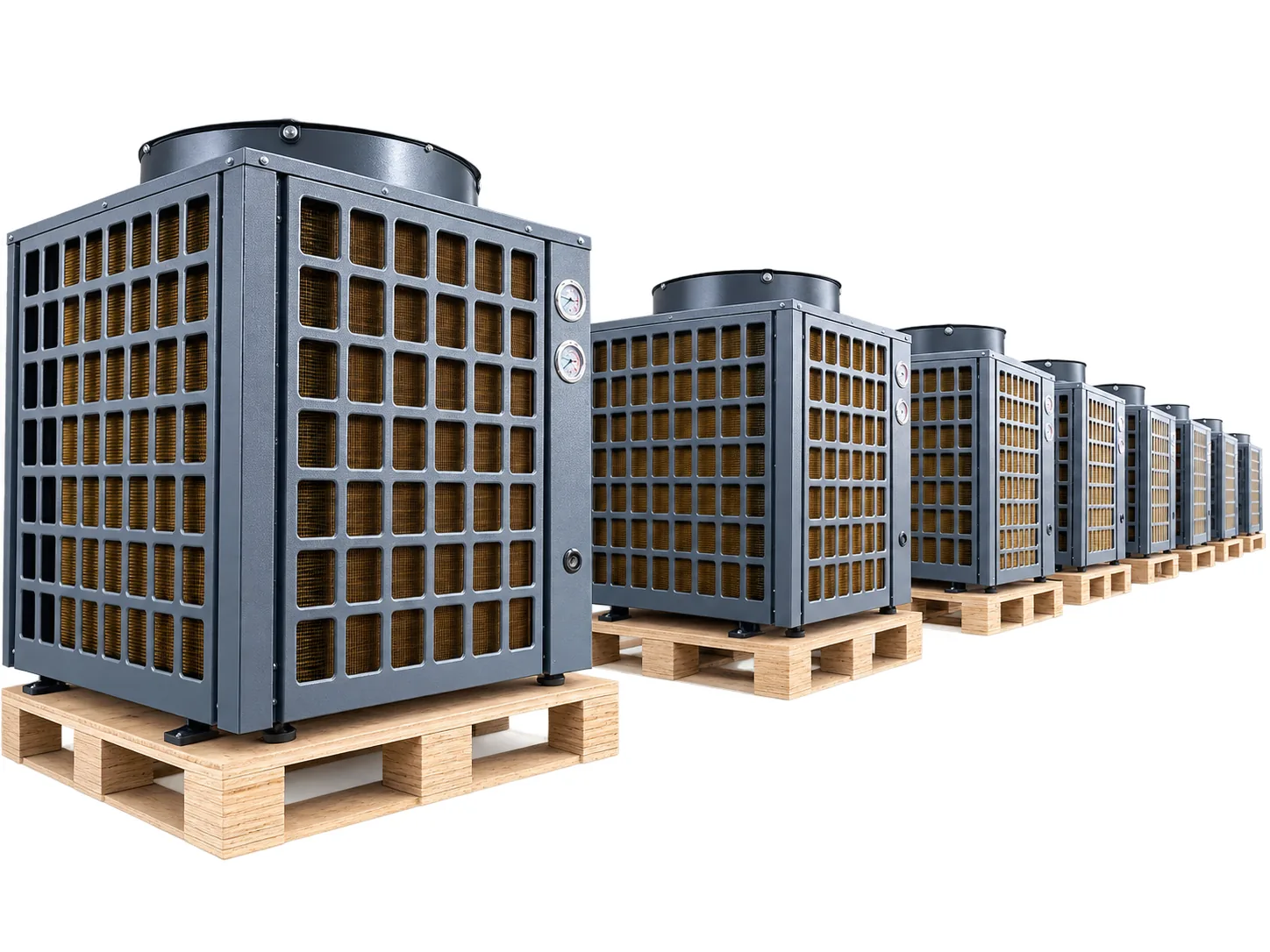
The honest summary: a standard air-cooled chiller is a workable, lower-cost entry point — but only if the marine retrofit is done properly and the site can tolerate its noise, footprint and ambient-temperature sensitivity.
Option 2: Delin Water-Cooled Chiller (DL-E150R5F-A)
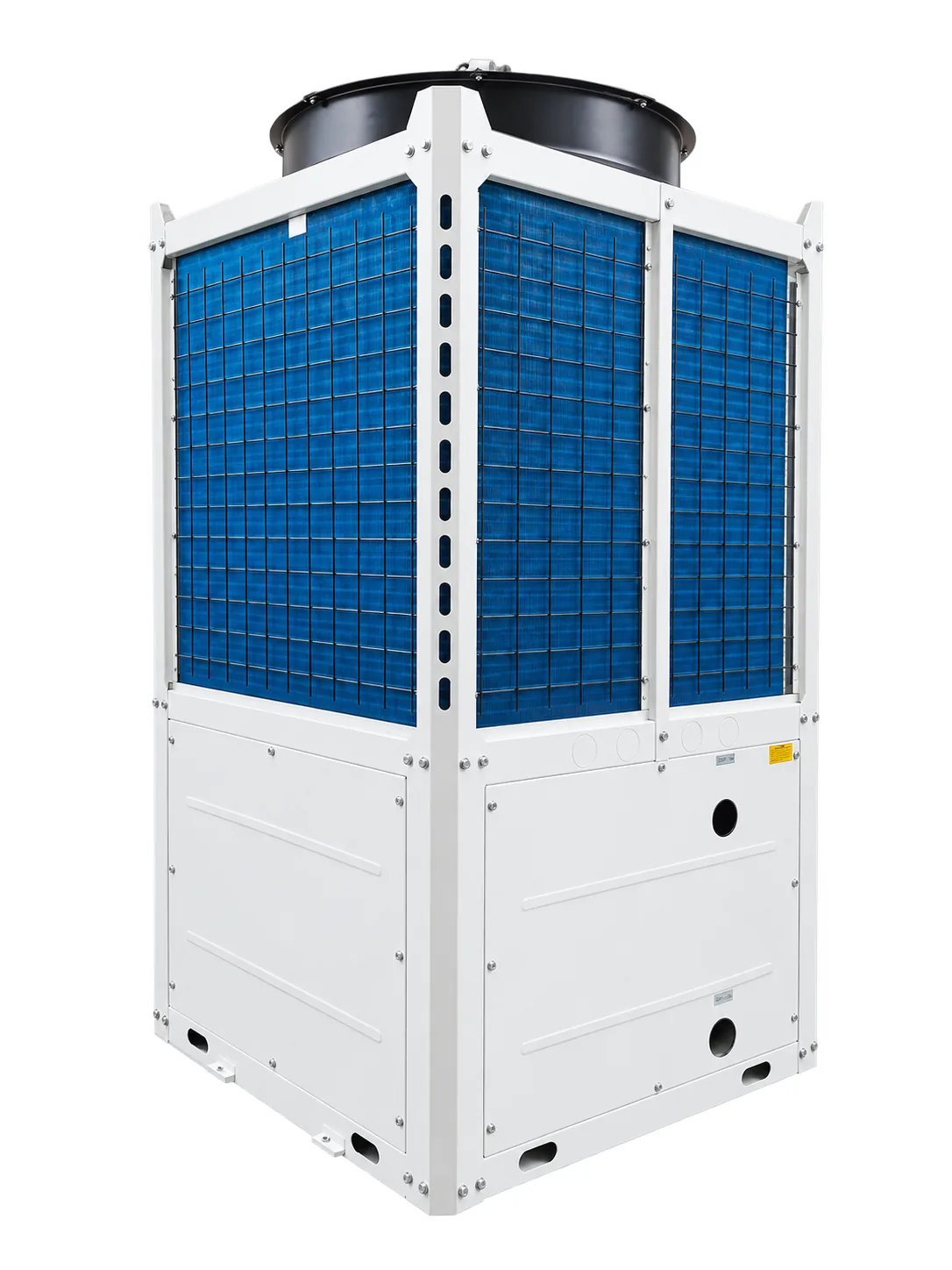
For marine ecosystems and high-salinity applications, Delin builds a dedicated machine — the DL-E150R5F-A (15 HP) — around a 100 % pure-titanium heat exchanger and a heavy-duty anti-corrosion cabinet. It is the same DL-E platform used across Delin's seafood constant-temperature machines, sized up for large display and holding systems.
| Specification | DL-E150R5F-A (15 HP) |
|---|---|
| Nominal cooling capacity | 43.4 kW |
| Power input / COP | 13.48 kW / ~3.22 |
| Water-contact material | 100 % pure titanium (zero heavy metals) |
| Water flow rate | 18.0 m³/h (2.0-inch internal thread) |
| Condenser protection | Hydrophilic blue fins + heavy powder coat |
| Dimensions (L × W × H) | 940 × 948 × 1890 mm (vertical) |
The advantages
- 100 % titanium aquatic safety. Zero copper and zero heavy-metal leaching protects the livestock most sensitive to trace-metal toxicity — SPS and LPS corals, elasmobranchs (sharks and rays), and rare marine specimens. A titanium exchanger never poisons the water the way a corroding alloy one can.
- Built for coastal corrosion. High-density blue-fin anti-corrosion coatings and a heavy-gauge galvanised, powder-coated steel enclosure stand up to aggressive salt fog and high-humidity marine plant rooms.
- A vertical footprint that scales in parallel. The vertical air-discharge design (940 × 948 mm base) lets multiple units sit side-by-side in a constrained plant room or outdoor equipment platform — the key to cooling very large tanks.
- High-flow efficiency. An optimised internal flow path (18.0 m³/h) keeps hydraulic head loss low, matching the demands of a large Life Support System (LSS).
The disadvantages
- Higher initial outlay. Premium materials — commercially pure titanium plus specialist protective coatings — cost more up front than a standard industrial unit. For a marine system, that premium buys safety and lifespan; it is not a free upgrade.
Side-by-Side Comparison
| Feature / Metric | Standard Industrial Air-Cooled Chiller | Delin Water-Cooled Unit (DL-E150R5F-A) |
|---|---|---|
| Water-contact material | Retrofitted PVC / standard alloy | 100 % pure titanium (non-toxic) |
| Condenser fin protection | Standard gold / hydrophilic aluminium | High-grade anti-corrosion blue fins |
| Nominal cooling output | ≈ 45 kW | 43.4 kW (15 HP class) |
| Enclosure durability | Standard industrial sheet metal | Reinforced powder-coated cabinet |
| Footprint | Horizontal / wide (≈ 1500 × 785 mm) | Vertical / compact (940 × 948 mm) |
| Target application | Freshwater / general industrial | Large marine aquariums & high-salinity LSS |
Sizing an Extra-Large Marine Aquarium (135 Tonnes)
Take a 9 × 6 × 2.5 m tank holding 135,000 litres (135 tonnes) of saltwater. A single 15 HP unit (43.4 kW) is not enough for peak thermal load — during pull-down after a water change, or at the height of summer, the load simply out-runs it.
The reliable answer is a multi-unit parallel arrangement, with each chiller on its own pump loop returning clean cold water to the tank:
| Parallel configuration | Total output | Best suited for |
|---|---|---|
| 2 × DL-E150R5F-A | 86.8 kW | Controlled indoor environments with minimal solar gain; basic redundancy and staged capacity control |
| 3 × DL-E150R5F-A | 130.2 kW | Public aquariums or facilities with intense LED / metal-halide lighting and high ambient exposure |
Three units land on roughly 1 kW of cooling per tonne of water — the benchmark ratio for rapid pull-down and step-load energy savings. With parallel units you also gain redundancy: one machine can be serviced while the others hold the tank, which is non-negotiable for high-value livestock. For the hydraulic side of running several chillers off shared headers — flow matching, pump sizing and balancing — see our aquarium chiller plumbing and flow matching guide.
Which One Should You Choose?
The decision is rarely about cooling capacity alone — both options can be sized to the same kilowatt target. It is about what the water side touches and what the plant room throws at the machine.
- Choose a standard air-cooled chiller when the water is fresh or lightly loaded, the plant room is dry and well-ventilated, noise is not a concern, and the budget is the binding constraint.
- Choose a water-cooled chiller when the tank holds corals, elasmobranchs or high-value marine stock, when the site is coastal or humid, when footprint and parallel scaling matter, and when the cost of a failed or corroding heat exchanger — in lost livestock, not just downtime — dwarfs the equipment premium.
That last point is the one experienced operators weight most heavily. A chiller that fails quietly in a marine system does not just stop cooling; if its water side corrodes, it can poison the very tank it was bought to protect. For large marine aquariums, titanium is not an upgrade on a checklist — it is the difference between a cooling machine and a marine-safe cooling machine.
For smaller marine and reef systems, our marine reef & coral aquarium chiller guide covers single-unit selection in detail, and our commercial aquarium chiller guide walks through the space and noise constraints of hotel, mall and restaurant installations.
Send us your tank dimensions, livestock, lighting load, ambient conditions and target temperature — our engineers will calculate the heat load and recommend the exact DL-E model (and parallel configuration) for your marine system.