Optimizing Pāua Farming: Precision Water Cooling for New Zealand Abalone RAS & Live Holding
Why New Zealand Pāua (abalone) farms need precision titanium chillers for land-based RAS and pre-export live holding — and how ±0.5 °C seawater cooling protects survival, growth and export quality.
New Zealand produces some of the world's finest blackfoot abalone — known locally as Pāua — and increasingly it does so on land. From recirculating aquaculture systems (RAS) around the Marlborough Sounds to grow-out facilities across Canterbury and the South Island, more Kiwi producers are moving abalone indoors to control the one variable that decides survival and growth: water temperature.
Whether you run a hatchery, grow out juvenile Pāua, or condition mature abalone for live export, precision cooling is the foundation of your margin. This guide explains why temperature is so tightly linked to Pāua performance, and what to look for in a chiller built for New Zealand seawater.
Temperature Control in Pāua Aquaculture
Pāua are cold-water animals with a narrow thermal tolerance. Even a small deviation from their comfort zone translates directly into slower growth, higher stress, and — in the worst cases — mass mortality. The danger points are well established:
- Above 18 °C — heat stress. Elevated water temperature suppresses the immune system and sharply raises the risk of bacterial infection and disease outbreak.
- 12–15 °C — the optimal window. This is the band for maximum growth and feed conversion ratio (FCR). Holding water here maximises daily weight gain per kilogram of feed.
- 8–10 °C — pre-transport conditioning. Before export, cooling water slowly lowers metabolic rate, slows respiration, and preserves energy reserves — the single biggest lever for survival on long-haul live shipments to Asian markets.
The conclusion for any producer is simple: temperature fluctuation is the enemy. Pāua tolerate a stable 14 °C far better than a system swinging between 12 °C and 18 °C. A chiller that holds temperature within ±0.5 °C is the difference between a profitable cycle and a lost one.
Why Seawater Demands a Titanium Chiller
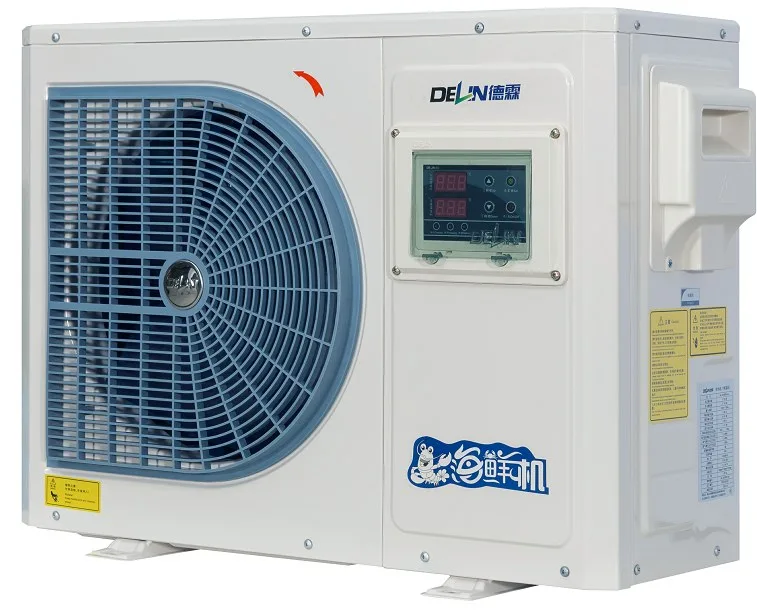
An aquaculture chiller does more than cool water — it must survive the most corrosive fluid in industrial cooling: continuously circulating seawater. This is why leading producers across Australia and New Zealand insist on equipment purpose-built for marine conditions. Delin's aquaculture chillers — built on the same DL-E platform as our aquaculture water chillers — are engineered for exactly this duty:
- 100% pure Grade 2 titanium heat exchanger. Seawater destroys ordinary copper and aluminium exchangers in months. Titanium resists corrosion and biofouling, never releases metal ions into the water, and lasts for years — critical when even trace copper can poison sensitive stock.
- Microcomputer temperature stability (±0.5 °C). Precision control prevents the sharp swings that trigger heat stress and metabolic shock, across a working range of +5 °C to +35 °C.
- Industrial-grade reliability. Copeland, Emerson and Panasonic compressors rated for 365-day, 24-hour continuous duty — because aquaculture never takes a day off.
- Energy efficiency for 24/7 running. R410A refrigerant and optimised heat exchange keep COP high and running costs low, a real factor given New Zealand's industrial electricity pricing.
- Quiet, humid-room build. Below 55 dB for indoor hatcheries, with an anti-corrosion casing for salt-laden air.
- Configurable power supply. Standard machines ship for 220 V/50 Hz single-phase or 380 V/50 Hz three-phase, and we build 220 V/60 Hz three-phase and 415 V/50 Hz three-phase units on request to match your local grid — no external transformer needed.
Colder water also holds more dissolved oxygen, so holding a stable low set-point directly supports the high stocking densities that commercial live holding depends on.
Choosing the Right Chiller for Your Pāua Setup
Not every stage of production has the same cooling demand. Matching the machine to the application avoids paying for capacity you don't need — or under-cooling a system where the margin for error is zero.
| Application | Recommended configuration |
|---|---|
| Hatchery & nursery | Microcomputer precision control and an anti-clogging design that protects larvae from fine particulates |
| Grow-out RAS systems | Modular, parallel units with high-flow titanium heat exchangers sized for continuous recirculation |
| Live holding & export | Fast pull-down to 8–10 °C, multi-point safety alarms (water-flow loss, over-temperature protection) |
Capacities run from 2.8 kW to 85 kW (1–30 HP) per machine; large farms simply run several units in parallel. Sizing depends on water volume, stocking density, ambient temperature and set-point — not tank size alone. Send us your tank or raceway volume, water type, and target temperature and our engineers will calculate the heat load and recommend the exact capacity. If you are also sizing for hatchery or nursery tanks, see our fish hatchery and nursery chiller guide.
Protect Your Pāua Stock with Factory-Direct Cooling
The difference between a profitable Pāua cycle and a lost one is often a few degrees held steady across weeks of grow-out and the final export run. Delin HVAC is the manufacturer — not a trading company — and AquaChill Tech is its official global export brand. MOQ is just 1 unit, standard models ship within 15–25 days, and customized capacities within 25–40 days, each with a 24-month warranty.
Planning to upgrade your Pāua farm cooling system, or setting up a new live holding facility in New Zealand? Contact our engineering team for custom aquaculture chiller sizing and design — engineered for seawater, sized for your biomass, and built to run year-round.
Related reading: Live Seafood Holding & Air Freight Temperature Control — how ±0.5 °C seawater cooling protects mussels, oysters and rock lobster through depuration and pre-air-freight chilling.