How to Identify a Fake 5HP Water Chiller — The '3HP Disguised as 5HP' Scam & Buyer's Guide
Buying a 5HP water chiller? Learn the five tell-tale signs of a 3HP unit relabeled as 5HP — fan count, cabinet height, compressor displacement and electrical specs — before you pay.
In industrial cooling, aquaculture, ice baths / cold plunges and various temperature-control applications, the 5 HP water chiller has become a popular specification thanks to its strong cooling capacity and high cost-effectiveness. But as market competition intensifies, some disreputable manufacturers and traders relabel 3 HP chillers as 5 HP to cut costs and inflate margins.
This mislabeling does more than cause insufficient cooling and a failure to reach the target temperature — it also creates serious safety hazards because the electrical parameters no longer match the nameplate. Drawing on first-hand manufacturing experience, this guide shows you how to verify a genuine 5 HP chiller across four dimensions: exterior structure, compressor model, power-supply parameters and internal component quality.
1. Exterior & Heat Dissipation: Single Fan vs. Dual Fans
In air-cooled water chillers, the condenser's heat-exchange area directly sets the upper limit of cooling performance.
A genuine 5 HP chiller:
- A 5 HP compressor delivers roughly 12–15 kW of cooling (about 42,000–50,000 BTU/h). Because it rejects a large amount of heat, it needs a finned condenser with a correspondingly large surface area.
- The vast majority of standard 5 HP chillers use a dual-fan (double fan) cabinet, typically 1,200–1,400 mm tall.
A 3 HP chiller disguised as 5 HP:
- To save on the housing and condenser, mislabeled machines usually keep the single-fan cabinet built for a 3 HP unit.
- Single-fan cabinets stand only about 800–1,000 mm tall. Even with "5HP" or "48,000 BTU" printed on the nameplate, the restricted heat-exchange area will trigger high-pressure cut-outs or severe cooling degradation in high-ambient conditions.
Rule of thumb: any "5 HP chiller" with only a single fan and a cabinet under 1 meter tall is almost certainly a relabeled 3 HP machine.
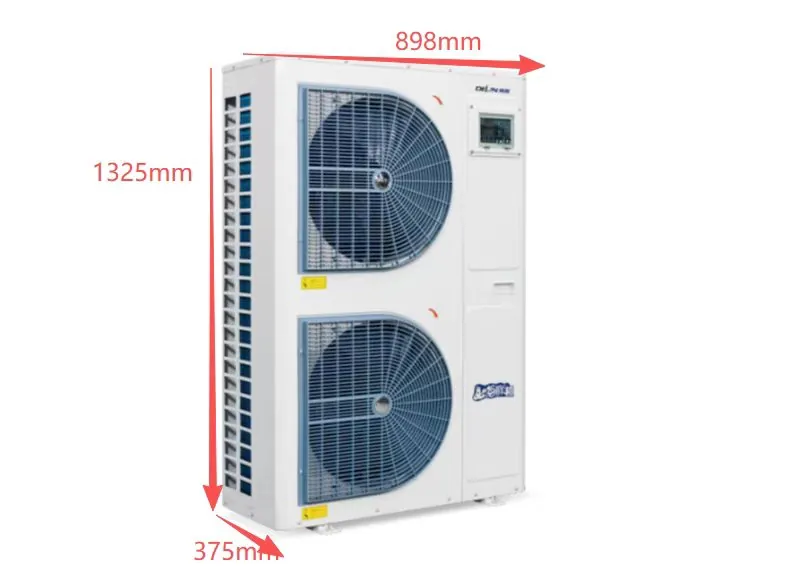
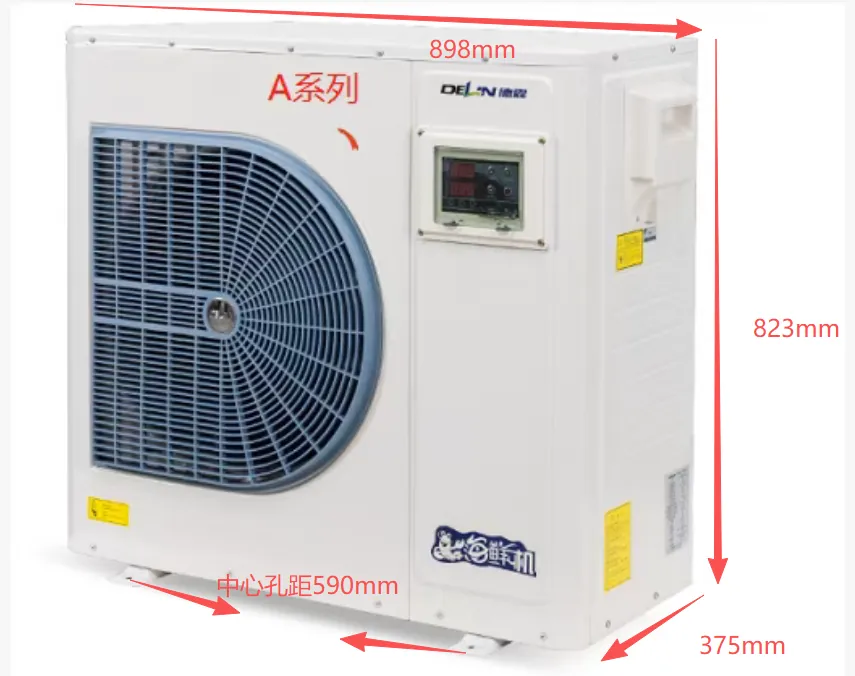
2. Compressor Model & Nameplate: The Most Direct Hard Evidence
The compressor is the heart of a chiller and its highest-cost component. The most reliable way to verify horsepower is to open the casing and read the original nameplate on the compressor body.
Check displacement and model number:
- 3 HP compressors: typical displacement is around 30–42 cc/rev.
- 5 HP compressors: standard models from major brands (Copeland, Panasonic, GMCC, etc.) usually have 50–68 cc/rev or more.
Check motor input power:
- 1 HP ≈ 735 W of electrical power. After accounting for motor efficiency, a genuine 5 HP compressor draws roughly 3.8–4.8 kW.
- If the compressor is rated at only 2.2–2.8 kW, it is fundamentally a 3 HP unit — whatever the exterior label claims.
3. Power Configuration: Three-Phase (380 V) vs. Single-Phase (220 V) Hazards
In standard industrial practice, genuine 5 HP chillers prefer three-phase power (380–415 V).
Why single-phase (220 V) 5 HP chillers are prone to failure: many buyers request single-phase (220 V / 60 Hz or 220 V / 50 Hz) 5 HP units because their facility lacks three-phase power, but single-phase 5 HP units carry inherent physical drawbacks:
- Excessive running current: a 5 HP unit draws around 4.5 kW. At 220 V single-phase, its rated running current reaches 20–23 A, and locked-rotor current (LRA) can spike to 80–100 A.
- Burned terminal blocks and relays: continuous operation above 20 A generates a lot of heat. If terminal blocks, contactors or wiring are not strictly rated, terminals can melt or even start a fire.
The "deceptive trick" of fake 5 HP units: unscrupulous makers exploit buyers' lack of electrical knowledge by printing 220 V / 20 A / 4500 W on the nameplate while installing a single-phase 3 HP compressor inside. When the machine "runs fine on a standard outlet without tripping the breaker," buyers assume it is energy-efficient. In reality, a 3 HP compressor draws only 10–13 A — far below a real 5 HP unit.
For a deeper look at why high-capacity chillers should run on three-phase power, see our guide to single-phase vs. three-phase seawater chillers.
4. Comparison Table: Genuine vs. Fake 5 HP Water Chiller
| Feature / Metric | Genuine 5 HP | Fake 5 HP (3 HP relabeled) |
|---|---|---|
| Standard fan count | Dual fans | Single fan |
| Cabinet height | ~1,200–1,400 mm | ~800–1,000 mm |
| Rated cooling capacity | 12–15 kW (42,000–50,000 BTU/h) | 6.5–8.8 kW (22,000–30,000 BTU/h) |
| Input power | 3.8–4.8 kW | 2.2–2.8 kW |
| Running current (single-phase 220 V) | 20–23 A (high terminal-burn risk if unoptimized) | 10–13 A (disguised as low power draw) |
| Compressor displacement | ~50–68 cc/rev | ~30–42 cc/rev |
| Standard power supply | 3-phase 380 V (recommended) | Single-phase 220 V |
5. Summary and Inspection Checklist
If you suspect your 5 HP chiller is mislabeled, verify it in three steps:
- Check the fan and height: is it a dual-fan unit over 1.2 m tall?
- Inspect the compressor label: open the side panel and read the compressor model number and displacement directly.
- Measure amperage with a clamp meter: measure current at full-load cooling. If a single-phase 220 V unit draws only 10–13 A, it is a fake 5 HP machine.
Buy a Genuine 5 HP Chiller Direct from the Factory
Every Delin chiller ships with a verifiable nameplate — compressor model, displacement, voltage and current — backed by factory inspection before dispatch. Tell us your cooling load and available voltage, and our engineers will size a genuine 5 HP (or correctly sized) unit for your process. Request a quotation.